



With just a single drop of blood, a Tulane University research lab can determine blood clotting through its physical properties, like viscosity and elasticity, and the technology is now ready for production.
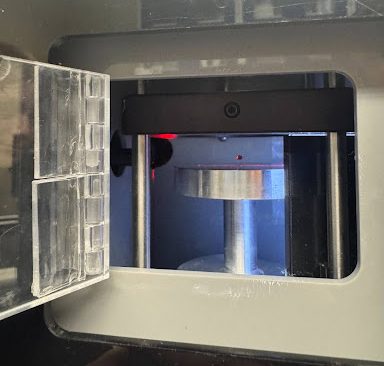
The lab is led by Damir Khismatullin, associate professor of biomedical engineering. The room hosts a myriad of acoustic tweezing devices — technology that uses sound waves to suspend and measure the viscosity of a drop of blood. Peering through the machine’s window reveals the sight of a mysteriously levitating drop.
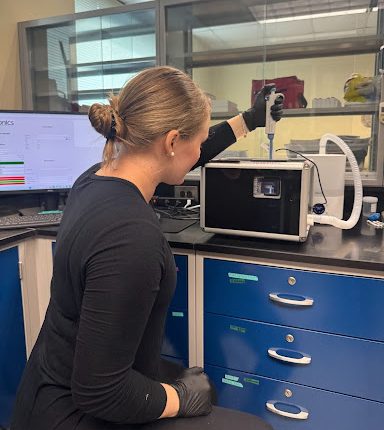
In reality, the technology is rooted in carefully engineered wave phenomena. McKenzie Cummins, a PhD candidate and lab member of five years, has been working on the newest model of acoustic tweezers, named Yosemite.
“[There’s a] transducer that’s emitting an acoustic wave at a certain amplitude, and then a reflector at the top. And as that wave emits upwards and reflects … and that creates nodes where you’re able to levitate droplets,” Cummins said.
Cummins then uses a program to control the strength and amplitude of the acoustic pressure to “squeeze or relax” the drop at different frequencies. At the same time, an internal camera tracks visual differences. These measurements of viscosity changes over time assess various aspects of coagulation.
Cummins recently worked with pediatric patients who rely on extracorporeal life support machines to circulate blood, thereby supporting the function of their lungs and hearts externally. She used the acoustic tweezing devices to assess the effectiveness of administered anticoagulants that prevent blood clotting within the circuit.
The novel device addresses limitations of other blood coagulation techniques. Turbidimetry is a technique that measures the levels of particulate matter in blood by determining the amount of light that passes through it. Standard turbidimetric methods often result in the discarding of many samples due to artificial turbidity caused by hemoglobin or other naturally occurring proteins. However, Khismatullin’s device bypasses the need for excessive processing, as these techniques can be performed on whole blood, which is a complete mixture of blood components.
Khismatullin said another advantage this technology presents is its small sample size.
“It’s one drop, four to six microliters in volume,” Khismatullin said. If the sample is a biological fluid that is hard to obtain, a small sample is vital. Current standard methods to test newborn babies for hemophilic disorders cannot be performed on the day of birth, but Khismatullin’s device could change that. Beyond the biomedical engineering landscape, Khismatullin also envisions his device entering various other fields.
“[The] application is technology like the food industry, like the oil and gas industry, chemical industries,” Khismatullin said. “We can measure the polymerization using our techniques.”
The outlook on intervention possibilities is optimistic. “At least one of the devices … I think is very close to public use,” Khismatullin said. “As soon as [the acoustic tweezing device] is FDA-approved, we can start selling this.”
Cummins said that there is already a device in use at the Tulane Center for Clinical Research. The device should easily integrate into the current healthcare field due to its simple operability.
Khismatullin is a proponent of undergraduates getting involved early on in their college careers. “Basically all students who actually start early in my lab become very successful in research,” Khismatullin said.
stewie • Sep 25, 2025 at 6:35 pm
You are so amazing Allison! i’m proud!
India Polacek • Sep 25, 2025 at 6:20 pm
Amazing work, Allison, so proud of the work you do!
Abby Hedrick • Sep 25, 2025 at 9:53 am
Amazing job, Allison!