



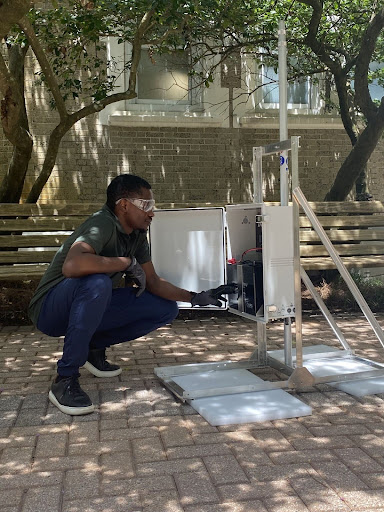
If you walk across Tulane University’s campus, you might notice a strange device sitting on the Academic Quad just past Percival Stern Hall. This machine houses CO₂ sensors that will soon contribute data to a national database for scientists to research the progression of climate change.
Annalisa Molini, associate professor in the River-Coastal Science and Engineering Department at Tulane, explained how the device functions.
“[The device] involves a gas analyzer that measures the concentration of water vapor in the atmosphere. And then you have this other instrument integrated [that] is really small […] and is essentially a sonic anemometer,” Molini said. An anemometer is a device that measures wind speed using pressure against a surface.
“So [in] tenths of seconds, you have all these measurements together, you can extrapolate essentially how hard those in the atmosphere are transporting the CO₂ and the water vapor,” Molini said.
With the data from the new device, Molini wants to explore how scientists can help reduce the concentration of CO₂ in the atmosphere.
“Climate variability depends a lot on how much CO₂ is in the atmosphere. There is already a large community of scientists who are working on collective fluxes, and why? Essentially to [have] natural-based solutions to lower the concentrations of CO₂ in the atmosphere,” Molini said.
The data will be stored through the FluxNet, the world’s first open-path methane analyzer for eddy covariance studies, a way to measure the exchange of gases, water vapor and energy between the Earth’s surface and the atmosphere using fast-response instruments. The goal of the FluxNet system is to eventually provide enough data to form climate change solutions.
However, due to the nature of these devices, wetlands like those in New Orleans are often excluded from data collection. This project aims to create a model that can be easily removed during severe weather. Molini and the rest of the team want to ensure that vital ecosystems are no longer left out.
“There are thousands of stations that are doing that. Among these stations, there are very few wetlands. […] We all know how important wetlands are. They are important for buffering during tropical storms, to protect us from sea surge waves and they’re endangered,” Molini said. “We lost a lot of wetlands recently, […] so to be able to measure in these coastal ecosystems how carbon is fixed is quite important.”
The new device is better equipped to handle New Orleans’ weather because it is smaller and lighter.
“You [now] have an instrument that is easy to remove. It is small and compact. You assemble it so that, in case of an emergency, we can disassemble it and replace it very fast,” Molini said.
Molini’s ultimate goal is to synchronize the FluxNet data so that all parts of land are included in the efforts to cool down the planet.
“There is already a gigantic, huge effort to try to collect measurements everywhere, but we want to do our part here, trying to cover a gap. That is the gap of wetlands,” Molini said.