


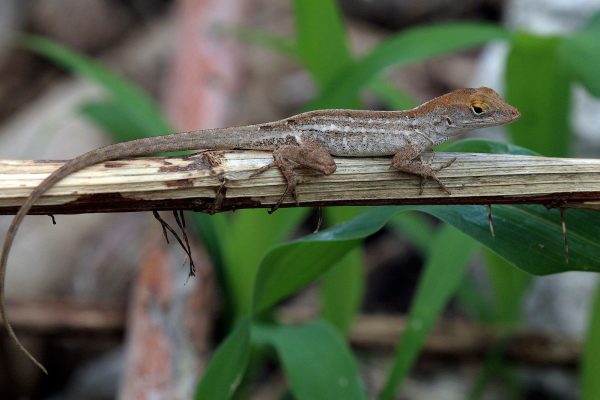
A recent study using New Orleans’ brown anole lizards to detect lead in urban areas found extremely high levels of lead contamination.
The study, led by Tulane University evolutionary biology Ph.D. student and U.S. Environmental Protection Agency biologist Annelise Blanchette, uncovered that the city’s Cuban brown anoles have the highest recorded blood lead concentration of any free-living vertebrate. The lizards had an average concentration of 955 μg/dL, with one lizard reading 3192 μg/dL.
No level of lead is safe in humans. For reference, the Center for Disease Control recommends anyone with a reading higher than 3.5 μg/dL to seek medical treatment.
Blanchette initially joined a Tulane project studying lead contamination in mockingbirds. When the COVID-19 pandemic made the procurement of research subjects difficult, she had to pivot. Cuban brown anoles, commonly seen skittering across the sprawling New Orleans sidewalks, proved to be an abundant and accessible source that would allow her to conduct research throughout the lockdown.
However, the redirection meant starting from scratch. Her first steps were to detect lead levels in the lizards.
“The world was my oyster. But that’s really overwhelming,” Blanchette said.
That leap of faith paid off. The results earned headlines in National Geographic, Smithsonian Magazine and Popular Science.
One of the study’s most remarkable findings was that the lizards studied displayed no outward harm from the lead levels. In fact, there was no negative impact on performance in traits usually affected by lead poisoning, such as balance, sprint speed and endurance.
The mechanism of tolerance remains unclear. However, Blanchette has a theory about what could be working behind the scenes — that the lizards are able to keep in their bloodstreams.
She hypothesized that the lizards may have elevated levels of micrometals in their blood that bind to the lead and prevent it from reaching the brain or other vulnerable organs until it gets excreted through waste.
Blanchette’s study sparked speculation about the implications of lead tolerance in humans.
“That could be something that translates into a medication … to prevent further damage from occurring,” Blanchette said. “But … that’s going to take a lot of work.”
Now, after completing her doctorate, Blanchette works at the Environmental Protection Agency. Notably, she warns against drawing overgeneralizations on the data.
“I do not want the takeaway for people to be [that] … the lizards are fine. That is not the takeaway,” Blanchette said. “I think the takeaway is that wildlife in our cities and even generally outside of our cities, are consuming the pollutants we put into the environment. We should still be sympathetic to the wildlife that we share cities with, and mindful of the pollution we create.”
Bahn Dubu • Oct 20, 2025 at 9:39 am
Thank you! I now will definitely NOT be eating these lizards