


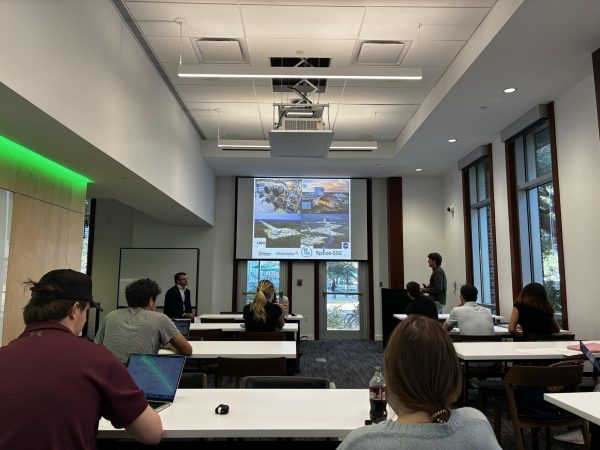
Tulane University is strengthening its interdisciplinary curriculum with the launch of a new undergraduate lecture titled Tech Ethics: What is a Better Future? this semester. The course, jointly offered by the School of Science and Engineering and the A.B. Freeman School of Business, aims to prepare students for a job market and economy shaped by advanced technologies. The Tulane course will enroll up to 15 science and engineering students and 15 business students.
The course is led by two Tulane faculty members whose research embodies the intersection of innovation, entrepreneurship and ethical inquiry. The first is Matthew Escarra, professor of electrical engineering, who specializes in photonics and energy-oriented engineering.
The other instructor is Rob Lalka, executive director of the Albert Lepage Center for Entrepreneurship and Innovation, an expert in business ethics and big technology. His work examines how organizations create value within complex social and economic environments.
Together, Escarra and Lalka guide students through the course’s central questions: How should society define a “good life” in the context of rapid technological innovation? Which economic, environmental, social or moral indicators should be used to assess benefits and risks across different groups?
“Our students need to engage with these topics, but we want them to do it in a unique way that’s from a very personal perspective,” Escarra said. “Meaning, what is their personal vision of a life worth living? … We ask them to think deeply about it for themselves, not just in an abstract sense.”
The course covers artificial intelligence, social media and bioinnovation. Other universities, including Stanford University and the Massachusetts Institute of Technology, also offer technology ethics courses that are primarily science-oriented. Tulane’s interdisciplinary approach toward technology ethics, which emphasizes both scientific and business innovation, differentiates this course from other institutions.
“I think one of the things that I’ve really enjoyed is that we have students who are coders, who otherwise have really good technical background as scientists, and then we have students who are finance and management majors who are focused on sort of the business implications,” Lalka said. “And so it’s been a really great classroom dynamic in that regard … [because] here you’ve got students who truly have been trained to think completely differently.”
Students can collaborate with regional startups and nonprofits that focus on climate resilience and technological innovation. The 2025 Greater New Orleans Startup Report found that 67% of entrepreneurs in the 10-parish region view artificial intelligence as their largest opportunity, and 77% expect it to have the biggest long-term impact on their business.
The New Orleans Bioinnovation Center has supported more than 225 new biotechnology firms, created over 650 high-wage jobs and raised more than $200 million since its 2012 launch. With artificial intelligence and technological innovation on the rise in New Orleans, the course will allow students to gain hands-on experience in technology ethics.
“The future is going to be determined by real people, real people making real decisions, and Tulane alumni are likely to be in those rooms … They’re likely to be developing or shepherding technologies, investing in technologies, guiding decision making around the future that we’re all going to share,” Escarra said. “You need tools to make an impact. And in this class, we get into [those] tools.”