


Although it never quite attains the horror of the novel from which it was adapted, “The Long Walk” is nonetheless a compelling drama, rich with political undertones.
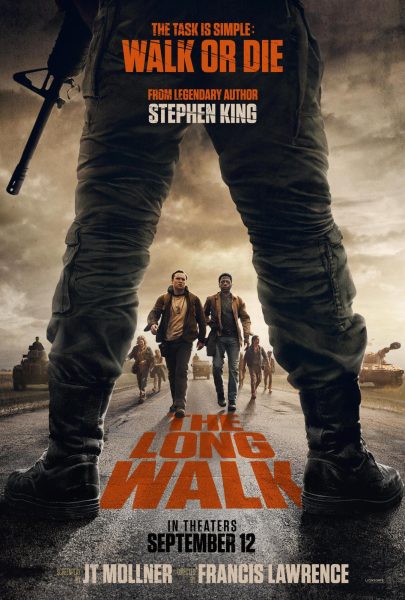
Adapted from Stephen King’s 1979 novel of the same name, director Francis Lawrence’s “The Long Walk” expands King’s rural horror universe, but the motion picture forgets how to run with the page-turner’s successes.
Depicting the empty highways and pastures of post-apocalyptic America, “The Long Walk” follows the trek of young Maine native Raymond “Ray” Garraty — played by Cooper Hoffman — and his eclectic company as they participate in the Long Walk, an annual, unending march that is nationally televised and promises to grant the winner whatever they wish.
Those who do not win will be shot dead.
Throughout the film, characters twist their ankles, trip over a missed punch, fall ill, succumb to lax bowels, suffer convulsions and have nosebleeds. Not one of these sudden troubles spares the otherwise healthy victims from joining the ranks of Long Walk losers.
The film’s first and youngest victim succumbs to cramping, shot down before the title credits. The rest walked on as I sat back in my comfy leather chair with an Icee. The film questions what it means to be an audience member of others’ physical trials. The Louisianians in theatres have to then wonder whether it is ethical to cheer on Baton Rouge-born character Art Baker, one of Garraty’s allies on the walk.
The film pales in several regards to the original text. The utter ghoulishness of the characters’ walk is lacking compared to the original novel.
The group erupts into panic with every death. While this conveys their innocence, it undermines the tragedy of the national desensitization to killing in the original novel. Without the cycle of sensitivity and lack thereof to each other, there is a loss of the boys’ more tender development.
However, the film does not totally sidestep the theme of desensitization. There are several moments in which the camera maintains focus on our protagonist as he continues to walk forward, leaving the fate of his unfortunate companions a blur in the background. Still, both the theme and the acting suffer when the characters’ jaws constantly drop at death.
The Major — played by Mark Hamill — is still around, but his curmudgeonly appearance is nowhere near as formidable and twisted as the gung-ho, big-grinning soldier of the novel. Yet old age perhaps fits well with the film’s emphasis on America at a time when the viability of the country’s political leaders is ever under question.
The spectators of the Long Walk are noticeably absent in the movie version. The book’s narrator says, “Crowd was to be pleased. Crowd was to be worshiped and feared. Ultimately, Crowd was to be made sacrifice unto.” In the movie, however, the apocalypse is mute and mostly visible in abandoned storefronts.
“The Long Walk” does not fail to make your heart race. Nor does it fail to remind your heart that this is not a race when the characters look out for each other. But in stressing the novel’s coming-of-age themes, the film endangers a fundamental question of the book. In its weaker comparison of the fiendish American crowds and decaying walkers than its source material, the film undermines this question that it also tries to answer: are we any different from each other? There are more steps to take.