

In recent years, politicians and leaders in the United States have been using the American right to free speech less like a right and more like a tool. Free speech has been utilized to advance their own political agenda, even if that means censoring others or disguising hateful speech as free speech. The line between free speech and hate speech has become so blurred that it no longer provides any real guidance; political polarization continues to blur the line further. The result is a culture where free speech is championed only when convenient, and individuals are villainized when their speech challenges opposing narratives.
The murder of conservative political activist, Charlie Kirk highlights these contradictions. Kirk was publicly assassinated while speaking at Utah Valley University on Sept. 10. Political violence corrodes democracy and undermines the American idea of pluralism. The public’s reaction to Kirk’s case was nuanced due to his vast repertoire of inflammatory rhetoric, often categorized as hate speech, which shows how words can harm communities and fuel divisions. Still, the idea that violence is an acceptable response to rhetoric sets a dangerous precedent. It exemplifies just how present the tensions are in our country between both condemning hate speech and defending its principle. One would think that the appropriate reaction to Kirk’s murder from both sides of the political spectrum would be unity to prevent a situation like this from happening again, but instead our leaders are escalating partisan attacks.
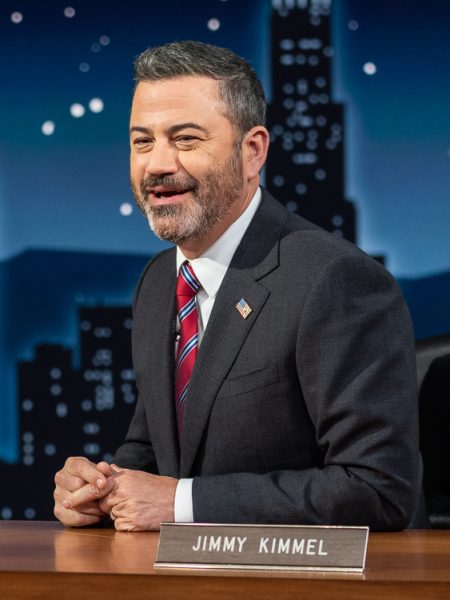
Figures like Donald Trump immediately capitalized on the assassination to amplify his own narratives. On an episode of Jimmy Kimmel Live! that aired on Sept. 15, talk show host Jimmy Kimmel addressed his disappointment in the United States administration in the aftermath of Kirk’s death, and how their main action after the events was to place blame. Kimmel acknowledged how political parties are trying to gain support from the tragedy, “The MAGA gang (is) desperately trying to characterize this kid who murdered Charlie Kirk as anything other than one of them and doing everything they can to score political points from it.” Kimmel’s statement communicated his broader concern that political leaders are prioritizing partisan gain over unity, deepening the country’s division.
Following the episode airing, Federal Communications Commission Chairman Brendan Carr publicly criticized ABC, warning that the network could face regulatory consequences if it did not take action against Kimmel. Under this pressure, ABC temporarily suspended the show. Past social media posts from Carr resurfaced, raising questions about the consistency of his stance on free expression. Unfortunately, this led to ABC abruptly pulling Kimmel’s show indefinitely on Sept. 17. Thankfully, ABC reinstated Kimmel’s show on Sept. 23rd.
Leaders who claim to defend free speech are often the first to silence it when it suits them, and this isn’t limited to any one political party. The left has its own track record of suppressing dissenting voices under the guise of protecting marginalized groups. While the justification seems moral, the suppression of free speech still occurs.
Harvard professor Carole Hooven, for example, publicly explained why she left the university after facing backlash for her views on gender and biology. Hooven, an evolutionary biologist, was forced to resign, because she stated that a person’s sex is biological and binary. These statements were rooted in her scientific research.
Our political and cultural leaders do not truly support free speech. They support selective speech, speech that reinforces their power, their party or their worldview. When speech runs against the grain, they condemn it as dangerous, hateful or disinformation. When it aligns with their agenda, it is celebrated as brave, necessary or patriotic. Until society begins to consistently defend the right to speak, our First Amendment will remain less a universal right than a political tool.
Who knows how far this politically motivated repression of free speech could span, maybe even to campus publications like the Tulane Hullabaloo. I think that our leadership must do a better job at promoting free speech on both ends of the political spectrum, while also drawing a starker line between free speech and hate speech for our country to adopt.
Kristine Lisi • Sep 29, 2025 at 10:39 am
As long as reporting, and articles like this, continue to be biased, there will be no change in this country.
Eric S Carboneau • Sep 29, 2025 at 10:11 am
I don’t care one way or the other about the politics or religion of the murder victim. I do care that a person has been murdered. It is wrong to take another person’s life.