


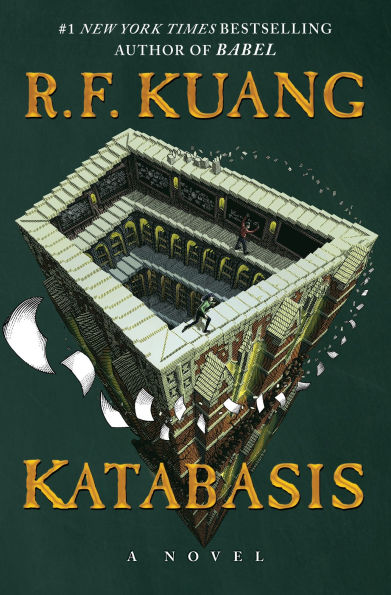
Academia is Hell. Figuratively and literally.
Set in the 1980s, R.F. Kuang’s newest novel, “Katabasis,” is a story about an overworked, desperate grad student who travels to the depths of hell in order to save her degree. Alice Law is a fourth-year student at Cambridge University. She is trying to complete her graduate degree in magick, a theoretical, philosophically-based magic system that uses paradoxes to power spells.
After years of sacrificing her sleep, physical well-being and social interactions, she is finally going to graduate with a recommendation from her callous yet well-respected professor, Professor Grimes. With this recommendation, she would have a free ticket for any job in academia. At least, that’s what would have happened if Professor Grimes hadn’t tragically died before she could finish her thesis.
Determined to make her years of borderline abuse worth it, she’s forced to team up with her biggest academic rival, Peter Murdoch, and travel to Hell to bring their professor back.
As Peter and Alice travel through the nine courts of Hell, their relationship turns from sour and competitive to something entirely different. Away from the delusional and unstable academic bubble, Alice goes through both professional and existential turmoil, trying to decide if it was all really worth it. As the journey progresses, she finds herself less and less sure in her answer.
Fans of “Yellowface” and “Babel” will be happy to know that “Katabasis” is an enjoyable read. The premise of it is seemingly ridiculous; who goes to hell for a Ph.D.? However, its absurdism is what makes this novel stand out. The premise promises light-heartedness and turns out to be anything but.
The magic system is fascinating, albeit hard to understand. I applaud Kuang for writing three original magic systems throughout her career. “Katabasis” magick relies on chalk, magic circles, linguistics, symbols, paradoxes and even sometimes blood. That’s all you really need to know to grasp the plot of the book; however, many of the more complicated aspects of magick, like hyperbolic math, might go right over readers’ heads.
The plot is established swiftly, as the reader is thrown into the action from chapter one. Kuang expertly avoids placing all the world-building at the beginning of the novel, and instead sprinkles it throughout the book. It’s a nice change of pace from Kuang’s “Babel,” which failed to have a tangible plot line until much later.
The main subtext throughout “Katabasis” is that academia is an unforgiving and ridiculously punishing discipline. The overly competitive and deprecating nature of prestigious academic institutions causes Alice to lose her mind throughout the journey. It’s an interesting topic, although it’s not Kuang’s first time exploring and criticizing academia.
The beginning of “Katabasis” is attention-grabbing, but the second half dragged quite a bit. Professor Grimes becomes a completely unlikeable character, and readers might be left wondering why the characters are still trying to bring him back from Hell.
What Kuang lacks in consistent plot development, she makes up for with likeable main characters. Even though “Katabasis” eventually loses the plot, the characters are enough to carry the end of the story.
Kuang has the “morally grey female protagonist” down to a science. Alice is cutthroat and flawed, and she knows and owns it. She is willing to do whatever she can to achieve her goals. However, she has an anti-feminist internalised misogyny subplot that feels out of character for her.
As a gangly, lovable dork, Peter is a gem. His personality can be flat at times, especially in comparison to Kuang’s other similar characters, like Kitsay from “The Poppy War,” who was practically jumping off the page, but he’s endearing, and a love interest that the reader can root for.
While “Katabasis” has more romance than Kuang’s other works, it is still not a romance-heavy book. The romance was entertaining, but it wasn’t particularly memorable outside of being a plot device. “Katabasis” is a contemporary fantasy first and a romance second.
“Katabasis” is certainly a good introductory novel for people who want to get into Kuang’s fantasy writing, considering it was much less dense than “Babel” and much shorter than “The Poppy War.” “Katabasis” was full of beautiful prose, existential thought and a sweet academic romance.