


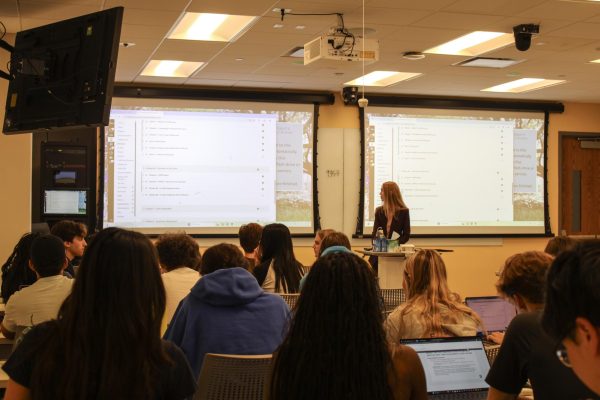
Tulane University President Mike Fitts surmised that artificial intelligence “may be one of the best things that’s happened to universities in a long time” in an op-ed in USA Today. Since then, use of AI by students has skyrocketed, forcing instructors to adapt quickly to the new technology.
In a Tulane-wide survey conducted last spring, 26.7% of Tulane students reported using AI daily, up from 19.1% in fall 2024. This trend is mirrored on college campuses globally; A survey by the Digital Education Council found that 86% of students use AI regularly in their studies.
Ignoring the technology’s growing role on campuses is impossible.
To prepare on an institutional level, Tulane commissioned Toni Weiss, director of Tulane’s Center for Engaged Learning, and Michael Griffith, director of the Innovative Learning Center, to co-chair a committee on AI in the classroom. From November 2023 to April 2024, they worked with academic representatives to explore the integration of AI into classrooms and the potential challenges it could pose.
“Without a unified response from the institution to this challenge [AI], we risk devolving into gamesmanship, where our students merely race to meet the basic requirements of their programs without fully engaging with or thinking comprehensively about their work,” the committee report states.
The committee generated recommendations for how Tulane faculty could best use AI when teaching, emphasizing transparency, individualized learning and continuing adaptation.
Since that committee, Weiss said, there is a wide range of how faculty are engaging with the technology, some choosing to prohibit its use altogether. But unlike some other technological tools, the role of AI on campus cannot be ignored.
“AI is something that you [faculty] need to know about because whether you are engaging with it as a faculty member, certainly your students are engaging with it. An understanding of the way that tool is shaping community is key,” Griffith said. “We need to make sure our faculty is equipped with the skills to really understand what’s going on.”
To that end, between the CELT and the ILC, faculty have had a “plethora” of opportunities to learn about AI, according to Weiss. Overall, Weiss has found that faculty are willing to engage with the tools, even after some initial hesitancy.
In the Tulane survey taken in spring 2025, 24.3% of instructors reported that they had integrated “some” AI into their coursework, compared to 54% who have not integrated it at all.
In Tulane’s B School
In Tulane’s A. B. Freeman School of Business, students and faculty are using an AI program, BoodleBox, to reimagine learning with AI tools.
Business school associate professor J. Cameron Verhaal chairs the committee that launched BoodleBox as a pilot program last spring. He described BoodleBox as a mix of ChatGPT, Slack and Dropbox.
The program provides students with access to multiple AI models in one interface. The tool can review financial data, generate AI tools for business models and create custom bots to mimic business negotiations, allowing students to practice on them.
Verhaal said the goal of the initiative is for students to develop AI literacy and monitor its use in the classroom, since avoiding students’ use of AI altogether is near impossible.
Verhaal said his thought process was twofold when faced with questions of working with AI. First, students will use the technology whether or not classrooms adapt. Second, having AI competency is a competitive advantage in the job market, so BoodleBox is intended to teach Tulane students to use the technology responsibly and transparently.
A pilot rollout of BoodleBox launched last spring in seven courses, serving approximately 150 students. Based on feedback from faculty about learning outcomes, Verhaal said the rollout was “very successful.” This semester, BoodleBox is available to any business school instructor who wants to use it in their classroom.
Currently, 27 courses have integrated the program in some way, reaching about 1,400 business students, according to Verhaal.
On A Quad
Even without elaborate pilot programs, humanities instructors are finding unique ways to adapt to AI use.
Matthew Griffin, a writing faculty member of the Department of English, has shifted his introductory writing course this year to focus on AI for the first few weeks of the semester. He instructs students on the negative environmental impact, intellectual property concerns and privacy issues associated with the technology. Then, he asks them to open up their computers.
Throughout the semester in his class, students will explore how AI may be useful in the writing process as a tool for revision. Griffin said he wants students to analyze how their thinking changes when they use the technology.
Early research suggests that AI has extreme negative consequences on cognitive ability, critical thinking and creative thought when used at the beginning of the writing process. But when used at the end to polish work, it may be productive, according to Griffin.
Weiss described a professor using AI to teach about bias by having the bot generate images of a doctor, a nurse and a sanitation worker. Unsurprisingly, the bot generated a white male doctor, a female nurse and a dark-skinned sanitation worker.
Concerns
Along with opportunities for engagement and efficiency, there is also room for shortcutting learning with AI tools.
“One of my concerns is that students are offloading a huge amount of their learning to AI and then turning around and blaming the faculty that they’re not learning anything,” Weiss said. “Maybe the faculty should spend some more time thinking about how to create learning opportunities that are not so easily offloaded, but the students also bear some responsibility.”
As faculty navigate these new murky waters with AI models like ChatGPT, Gemini and Claude, Griffin suspects that students can expect more handwritten essays, blue books and in-person exams.
Not all business school faculty have jumped on the new technology either. Verhaal said some instructors don’t want to normalize AI use in the classroom, citing the unclear long-term implications of the technology.
These concerns are not unwarranted. AI raises concerns of data privacy, and for Verhaal, he is worried about the impact of replacing human interaction and students’ own thinking with AI interactions.
Faculty also cite data privacy as one of their main concerns about the technology. AI tools function by collecting a massive amount of data from users to recognize patterns and responses. For use in the classroom, there is a risk that private student and faculty information is shared outside of the university.
BoodleBox is a secure platform that does not use inputs from Tulane users to train its AI models.
At the very least, Verhaal said, he hopes Tulane will soon establish a set of best practices for use of the technology in classrooms.
“It’s going to transform higher education, and I think it’s going to transform multiple industries. I just don’t know exactly what it’s going to look like, but that’s the fun and scary thing about it,” Verhaal said.