


President Donald Trump and Secretary of Health and Human Services Robert F. Kennedy have claimed that prenatal exposure to Tylenol — a common pain reliever taken by nearly 65% of pregnant women — is linked to autism. Trump cited his “common sense” and personal opinion as the basis for this claim, struggling to pronounce “acetaminophen,” while urging pregnant women to “tough it out” instead of taking the medication.
The statement, made without supporting medical evidence, echoed a pattern of misinformation surrounding health and science throughout his presidency.
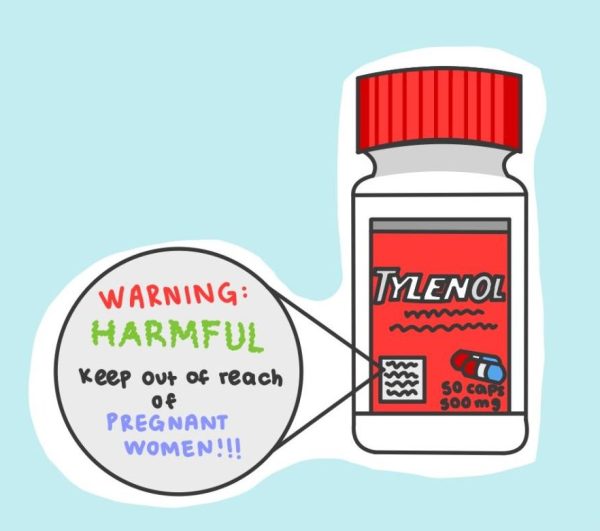
The claim was strange even for Trump, yet the intent behind it was clear: Drag women’s bodies into the political spotlight, once again.
The U.S. Food and Drug Administration quickly clarified that while some studies suggest an association between Tylenol use and autism, none prove causation.The American Psychiatric Association reaffirmed that acetaminophen, when used as directed, is safe during pregnancy.
When misinformation spreads from the highest office in the country, there is a clear agenda to control whoever is listening.
Tylenol has become the perfect political symbol because it sits at the intersection of two things the administration has repeatedly tried to regulate: trust in science and women’s autonomy. Declaring a routine medication “dangerous” reframes personal choice as recklessness, implying that women’s decisions need to be monitored, corrected or taken away altogether. It’s the same rhetorical move used against birth control, IVF and abortion; only now, the target hides in plain sight on every pharmacy shelf.
Beyond the pseudoscience, Trump’s “tough it out” mantra fits neatly into a historical pattern where women’s pain is minimized, pathologized or blamed on their own decisions. Even basic pains like a headache, backaches or a simple fever become grounds for public scrutiny.
Pregnant women, especially, are shamed for everything, from infertility issues to not getting pregnant fast enough to virtually every choice they make during pregnancy. Mothers are blamed, and in some cases criminalized, when they suffer the tragedy of losing their babies.
The pattern of condemning mothers for their babies’ developmental disorders has been around since at least the 1950s, when the “refrigerator mother theory” suggested mothers of children with autism were unloving, unattentive and ultimately the cause of their children’s condition.
The irony lies in scientific evidence actually showing a link between advanced paternal age during conception of the baby and an increased risk of autism and other developmental disorders. Yet, when the president fathered Barron Trump at 59, he called it proof of his youthful virility.
There is also a subtler implication behind the “Tylenol causes autism” narrative: that autism is something to be prevented rather than understood. Framing autism as a “horrible crisis” and an “epidemic” fuels society’s stigma toward the condition and justifies invasive oversight over women’s bodies “for the sake of the child.”
It reduces both women and neurodivergent people to political tools — one stripped of agency, the other of humanity.
By attacking a household drug, the administration is not just undermining public health; it’s establishing who gets to define truth. When Trump tells pregnant women to “fight like hell” before taking Tylenol, he is really fighting the very idea that science should guide healthcare. This pattern isn’t new. Each time the administration claims to “protect families,” it chips away at the authority of physicians and scientists.
Autonomy, scientific literacy and public trust are all fragile things. They require more than just data: They require leaders who respect evidence and the people they serve. The danger of this latest Tylenol panic is not just misinformation; it’s the normalization of distrust. The administration isn’t focused on the pain reliever; it is suggesting that women cannot be trusted to make informed choices about their own health.
Science does not need faith, but democracy relies on it. And every time truth is twisted into spectacle, both begin to weaken. Scientific fact isn’t abstract, harm isn’t hypothetical and public trust isn’t a prop. Next time — and there will be a next time — when a political figure plays doctor, turn to a real one instead.