

As a passionate Puerto Rican, I cannot describe the pride I felt when three-time Grammy Award winner, 12-time Latin Grammy Award winner and global phenomenon Benito Martinez, known as Bad Bunny, was revealed as Apple Music’s 2026 Super Bowl halftime show performer.
“What I’m feeling goes beyond myself,” Bad Bunny said, while wearing the representative Puerto Rican pava hat. “This is for my people, my culture and our history. Ve y dile a tu abuela, que seremos el halftime show del Super Bowl.”
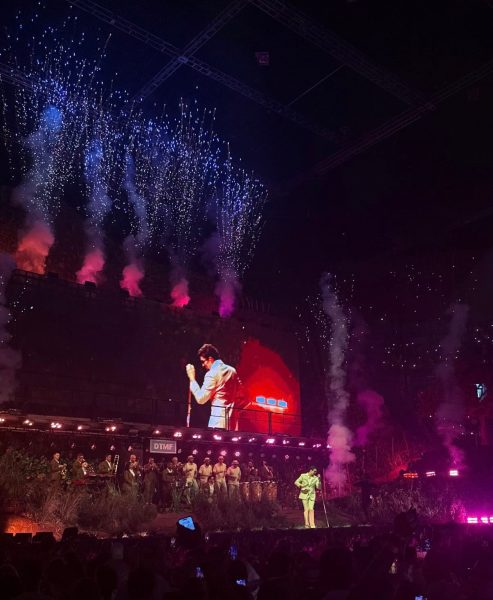
The announcement came as a perfect ending to his sold-out, historic 31-show residency, “No Me Quiero Ir de Aquí” at San Juan’s El Coliseo de Puerto Rico.
Unfortunately, not everyone shared that excitement. Over 14,000 people signed a petition to replace Bad Bunny with no alternative stated. Another demanded he be replaced with an “all-American” option: Texas country singer George Strait.
“The Super Bowl halftime show should unite our country, honor American culture, and remain family-friendly,” the petition reads. “Bad Bunny represents none of these values; his drag performances and style are the opposite of what families expect on football’s biggest stage.”
The outrage against a Spanish-speaking artist proud of his heritage grew so strong that conservative youth organization Turning Point USA announced a rival “All American Halftime Show” to run the same day as Super Bowl LX in Santa Clara, California. This followed Bad Bunny’s Saturday Night Live performance where he joked that Americans “have four months to learn” Spanish.
In response, TPUSA contributor Riley Gaines wrote on X, “No thanks. We’ll just have our own. Enjoy your low-rated halftime show.” Given the right wing’s history of underwhelming events, their “alternative” show likely will not draw a comparable crowd.
Unfortunately, this level of hate towards Bad Bunny is to be expected.
Bad Bunny embodies everything that provokes conservative outrage. He endorsed Kamala Harris for president in 2024, defies gender norms and opposes Trump’s anti-immigration policies. Detractors argue he does not appeal to broad audiences, which is strange given he is among the most streamed artists in the world. Even President Donald Trump chimed in, calling him an “absolutely ridiculous” choice, insisting he had “never heard of him.”
Yet much of the criticism centers on claims that he might turn the halftime show “into a political stunt” or that he is “not American enough.” A viral moment occurred when conservative commentator Tomi Lahren said Bad Bunny is “not an American artist,” not realizing Puerto Ricans are U.S. citizens.
For a nation that values patriotism, it is interesting how many Americans are ignorant of their own history. Puerto Rico was claimed by the U.S. in the 1898 Spanish-American War. Since then, it has been labeled an “unincorporated territory,” a term that both connects and separates it from the states, allowing the U.S. to treat Puerto Rico like a colony post-imperialism.
Puerto Ricans are born U.S. citizens yet lack voting representatives in Congress and cannot vote in presidential elections. Puerto Ricans are divided on our political future — some advocate statehood, others commonwealth status or independence — but all agree it is a nonsovereign land with a distinct Latin American identity, one of the oldest and most enduring cultures in the Americas. We exist in the in-between: American, but not quite; Caribbean, but not just.
Puerto Rico’s story is one of endurance: hurricanes weathered, migrations and returns, laughter through blackouts and protests. To be Puerto Rican is to live with the ache of what could be and the beauty of what already is. This is what Bad Bunny represents: Puerto Rico’s loud, unashamed heartbeat on the global stage.
It is no wonder conservatives fear the halftime show becoming political; visibility itself can be resistance. Bad Bunny does not argue for inclusion; he performs it, forcing audiences to confront their discomfort in real time. His refusal to tone himself down for the American mainstream is not alienating, it is liberating.
In a country where Latino identity is often flattened into stereotype, Bad Bunny insists on complexity, redefining masculinity, culture and unity. His art forces audiences to face history, and see how much progress remains undone. In doing so, he exposes the limits of tolerance: how quickly celebration turns to criticism when a Latino artist refuses to translate, apologize or conform.
Bad Bunny speaks up because he understands responsibility comes with influence. His refusal to tour the U.S. mainland out of fear that fans could be detained or deported by ICE shows his awareness that visibility can protect others. Bad Bunny uses his platform to defend the community that raised him.
For those still stressing about his performance, do not worry. It is only 15 minutes. You will get your football game back.
I am excited for those experiencing his artistry for the first time. I attended one of his 31 shows in Puerto Rico, and it was transformative.
His performance will be a love letter to Puerto Rico — a celebration of our resilience, rhythm and pride, reminding the world that representation is its own kind of power.