


On a cold day in rural Wisconsin, a chill must have run down the spine of the first witness to see the flies buzzing around what serial killer Ed Gein had done.
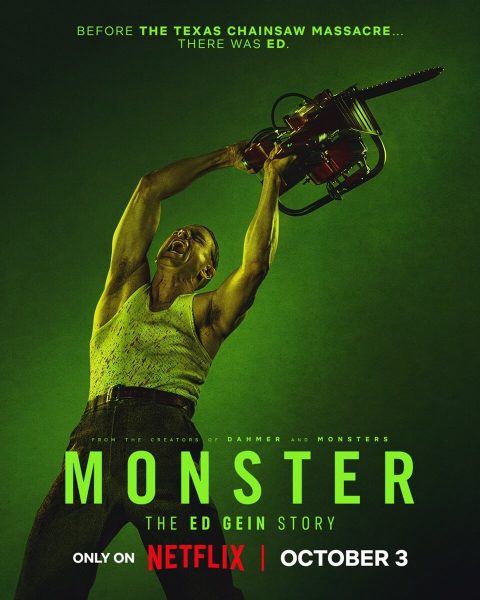 With “The Ed Gein Story,” the third installment of the Netflix series “Monster” and a chart-topper upon debut, creators Ian Brennan and Ryan Murphy present the behind-the-scenes of Gein’s life.
Born and raised in Plainfield, Wisconsin, Ed Gein — played by Charlie Hunnam — lives with his mother Augusta — played by Laurie Metcalf — a harsh Christian whom he dearly loves despite her tormenting him, rebuking him for masturbation and lust in his childhood.
“Mother,” as Gein continues to call her, also hates his only childhood friend, Adeline Watkins, played by Suzanna Son. Augusta Gein describes Watkins as “Pandora,” and allusions to this remark string out across the eight episodes.
In reference to the legend of Pandora, Watkins presents Gein with a box of morbid photographs and comics. Later, Alfred Hitchcock — played by Tom Hollander — reveals the sexual contents of Gein’s freezer-box to Anthony Perkins — played by Joey Pollari. Later, from the confines of an asylum, Gein sends ham radios in large wooden crates to two of his role models — one a Nazi and the other a famous transgender icon. There is also, of course, Gein’s habit of digging up bodies that may be another allusion to Pandora’s box.
There are scenes in the series that I would argue are scarier than some horror movies. In an early one, Nazi concentration camp victims besiege Gein’s house, pressing and screeching against it, then breaking through the windows like a zombie horde pursuing him. The camera angles are slanted, intensifying the feeling of turmoil and the world slipping from underneath.
Gein and his mother are two sides of the same depraved coin. Augusta Gein’s religious and moral strictness buries Gein’s agency in one scene, and while he shouts at his mother in warm orange light at the bottom of the stairs, she stands in blue shade at the top like a cold figure from a crypt.
Yet despite the relative warmth of his character, as also suggested by his humble personality throughout the series, it is Gein who kills people and unearths the dead. Watkins, becoming more Pandora-like, only eggs on his fascination for corpses.
The series’ horror faces a problem: Ed Gein appears charming and pathetic. When he dreams about killing one of his victims with a chainsaw, he maintains the same smile in ordinary encounters. When his psychiatrist reveals his final diagnosis to him, he is reduced to childish whimpering.
In different parts of the series, Gein seems alternately evil and gigantic and boy-like and timid. So how should we feel about Ed Gein? How should we feel about someone who is “both crazy and a killer,” as Gein says of himself?
It is Gein himself who implicates viewers and their desires with these questions by saying, “You’re the one that can’t look away.” Without him, there might not have been Hitchcock’s “Psycho,” Tobe Hooper’s “The Texas Chain Saw Massacre” or Jonathan Demme’s “The Silence of the Lambs.”
Gein is the puzzle-piece that connects them all, and the tragic irony is, as he says in the show, that “I just feel like I’m a puzzle, and none of the pieces fit. I have a feeling that they ain’t ever gonna fit.”
Gein may be right: The puzzle pieces of his life may never fit exactly. Some have criticized the “Monster” series for glorifying Gein’s violence. I agree that it does, but I argue that it does so intentionally to hold up a mirror to us.
Others have criticized the series for humanizing Gein. But it should, because this is our collective puzzle: A “banality of evil” exists. All humans — and Ed Gein was no devil, but a human — could commit terrible actions. “The Ed Gein Story” should be watched even if only for this sobering existential morsel.