


There is perhaps no name, and certainly no beer, more synonymous with Ireland than Guinness. After visiting Dublin this summer, Netflix’s “House of Guinness” is a series that I eagerly approached for a binge. However, creator Steven Knight’s series is too over-the-top and quickly loses its head.
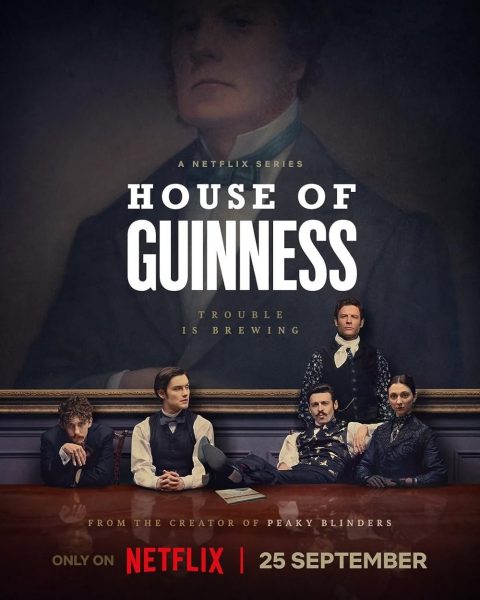
Inspired by true events, the show stars Arthur and Edward Guinness, played by Anthony Boyle and Louis Partridge. The brothers are heirs to the family’s famous brewery, but when they learn the terms of their father’s will, they are less-than-pleased. Arthur and Edward are not fond of each other, but the terms oblige them to work together for the benefit of the business.
Their younger sister Anne, played by Emily Fairn, and brother Benjamin, played by Fionn O’Shea, are also unhappy with the will’s conditions. The siblings spiral into conflicts and vices that endanger the family’s business and reputation.
These conflicts also entangle them in the debates surrounding Irish independence from Britain.
Visual metaphors allude to the siblings’ divisions. In the first episode’s intro sequence, the word “power” has its “w” hammered flat. This suggests that the siblings — four of them, like the remaining letters — are suddenly divided by the death of a central figure in their lives: their father.
Their father’s legacy continues to haunt them throughout the eight episodes.
The series’ Irish versus Unionist subplot is quite consistent, and not only in the script, but in the music. Kneecap, a controversial Irish hip-hop trio, is among the artists on the soundtrack. One of their featured songs is titled “Get Your Brits Out.”
The series ultimately feels more like a redacted exhibition of the Guinness Storehouse than it does a unique show. While the importance of Guinness factory coopers is only mentioned briefly, the drinking culture surrounding Guinness is unusually absent. The show mentions the “Guinness Minute” and The Brazen Head — the oldest pub in Ireland — but I would have liked to see even more references to Dublin culture and Guinness lore.
The fight scenes were also underwhelming. Skirmishes break out between Guiness Factory workers and members of the Fenian Brotherhood, a group in favor of Irish independence, but the action seems too reliant on viewers’ taste for similar productions, like “Peaky Blinders” — another series directed by Knight — and “Gangs of New York.” The disappointing fight scenes are a shame because brewery foreman Sean Rafferty — who does the family’s dirty work — is a more enjoyable character than the Guinness siblings. While the siblings are easily jostled by their new circumstances, Rafferty has always needed to adapt to the Guinness’ family wishes, whether harmless or brutal. In comparison, Arthur’s homosexuality only makes him appear like a shadow of the Irish poet and playwright Oscar Wilde, for whom being exposed as gay in late nineteenth-century Ireland was dangerous.
It is unclear whether “House of Guinness” will have a second season. If it does, the period piece should complement its compelling lore and historical references with characters that are more believably and individually developed. I would then gladly sip a pint of Guinness to it.
Chris simmons • Nov 13, 2025 at 3:52 pm
I could not stomach the entire hour of the first episode – 30 minutes was my limit. MUCH too much over the top (music, action etc). Not surprisingly, too much of Peaky Blinders about it (I have much the same complaints about that series as well). Probably appeals to twenty-something men – but not me.