


Tulane University was highlighted in The Association for the Advancement of Sustainability in Higher Education’s 2025 Sustainable Campus Index as one of 128 institutions with a silver rating, ranking in second of 384 institutions in sustainable food and dining.

AASHE’s index reports the top colleges and universities “across 13 impact areas of sustainability,” one of which is food and dining under the operations category. Tulane lost the top spot to University of California, Berkeley, the top-listed doctoral and research institution, in the newest version of the Sustainability Tracking, Assessment and Rating System.
The rating system, STARS, uses self-reported data to measure sustainability performance in five categories: planning and administration, innovation and leadership, academics, engagement and operations.

“The Sustainable Campus Index is a great resource for prospective students, faculty and staff, alumni and anyone with an interest in sustainable practices in higher education,” said Emily Slazer, sustainability manager of Tulane Hospitality. “Our inclusion on this list is a reflection of our shared commitment to sustainability initiatives.”
Drawing on the definition provided by the United Nations, Slazer describes sustainability as “the practice of meeting our current needs while maintaining and improving our planet’s health to ensure the needs of future generations will be met.”
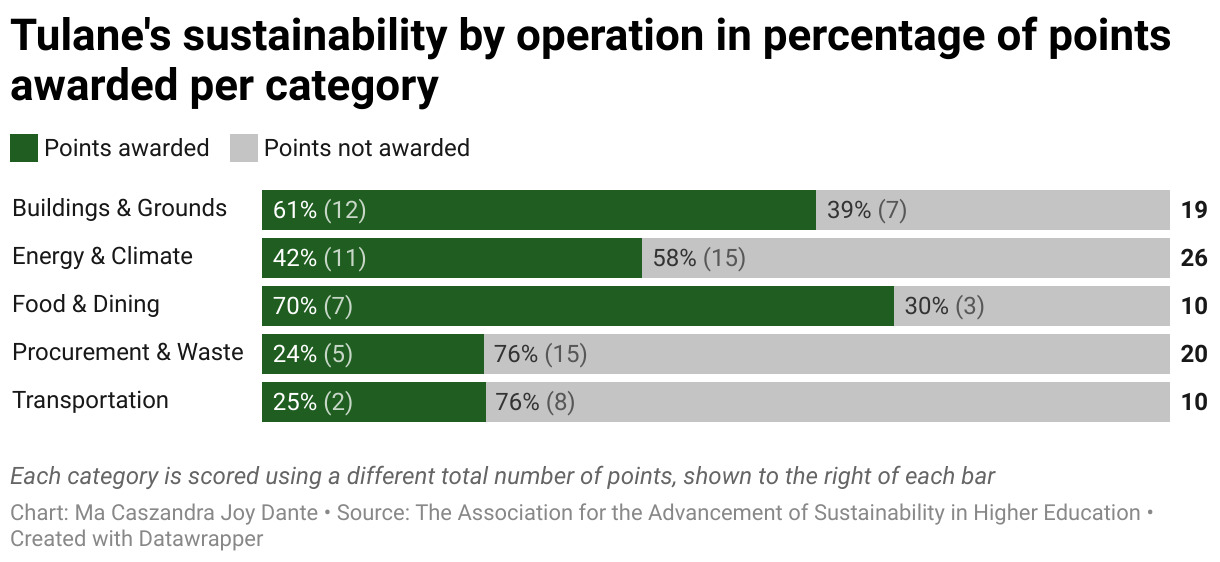
Tulane Hospitality collaborates with Tulane’s Office of Sustainability to reduce Tulane’s environmental impact and “implement more environmentally friendly, sustainable campus dining.” Tulane Hospitality launched a reusable container program in the Lavin-Bernick Center for University Life and Malkin Sacks Commons this year. Tulane Hospitality also partnered with Schmelly’s Dirt Farm to reestablish a composting program for the campus dining facilities.
“I’m very proud of our partnership with Schmelly’s Dirt Farm, which allows us to compost organic waste like melon rinds, vegetable peels and uneaten food left on our guests’ plates,” Slazer said. “While we always strive to decrease our food waste, having a productive outlet for the unavoidable food waste is hugely impactful.”
Part of Tulane Hospitality’s sustainability efforts focuses on sourcing locally grown food and incorporating climate-friendly meal options.
“We partner with Audubon GULF to incorporate more sustainable seafood options, and we exclusively serve gulf shrimp in our residential facilities. We’ve also started to purchase directly from smaller local farms, so we can offer our guests fresh and nutritious seasonal produce,” Slazer said. “It’s very exciting to serve produce that was harvested right here in Louisiana.”
Tulane Hospitality works with local vendors and farms such as Capitol City Produce in Baton Rouge and Williams Produce in Point Coupee Parish. Residential facilities now offer Coolfood Meals that have a 38% lower carbon footprint than the average meal.
“There’s so much we will do with support from Tulane students,” Slazer said. “I’m excited to expand local purchasing, offer more Coolfood menu options, continue to reduce food waste across campus and more.”