


Tulane University senior Dylan Murray was one of four founders of the biotech startup Exactics, which developed a revolutionary at-home testing kit for Lyme disease. Unlike traditional tick tests, QuickLyme allows the user to obtain results in just 15 minutes from an at-home test.
Traditional Lyme disease tests are usually blood tests collected by the patients and then mailed to labs. These tests measure immunoglobulin M, IgM, and immunoglobulin G, IgG — antibodies produced in the presence of Lyme disease bacteria detectable in blood.
Murray said that while such tests have long been the standard for diagnosing Lyme disease, they come with several drawbacks — particularly in terms of speed and accessibility.
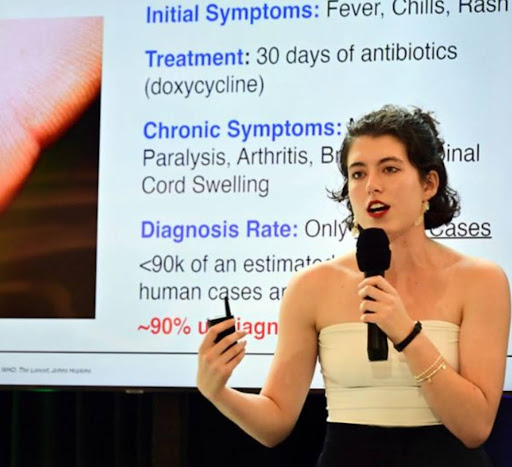
Also, to obtain accurate results, blood testing must be done within a specific timeframe: about three to four weeks after the bite, when antibodies begin to develop. But time is crucial when it comes to Lyme disease: the earlier it is detected, the less bacteria can spread, making the disease easier to treat with simple antibiotics.
With the challenges of delayed results and high costs in mind, Murray and her partners developed QuickLyme. QuickLyme works by testing the tick itself rather than the infected patient’s blood.
Murray said Julian Kage, chief executive officer of Exactics, first came up with the idea for this testing device after one of his best friends suffered from Lyme disease.
“One day at school, [Kage] watched the school nurse picking ticks off of kids. He thought, ‘Oh my gosh, this happens all the time! What if that is what we tested?” Murray said. “So, at 13, he invented this design for a test that is able to determine if a tick had transmitted Lyme disease.”
Years later, at the University of Chicago, Murray and Kage were lab partners in their first year biology class. They instantly connected, often competing to finish their lab experiments first, and became great friends. At the end of Murray’s sophomore year, after she transferred to Tulane, Kage called Murray up asking her to work for his new company, Exactics.
Murray spent about two weeks as an intern before becoming the company’s chief operating officer. As the only cofounder in New Orleans, Murray says she never expected to be starting a company in college.
QuickLyme is built on a larger diagnostic platform, Proteus+, which uses a lateral-flow immunoassay, a simple technique that detects antibodies in a sample. To use the QuickLyme test, the user removes the tick, crushes it, mixes it with a buffer solution and pours the mixture on the testing stick.
This simple technology — double lines for negative and a single line for positive — delivers clear, efficient results in minutes right at home.
Lyme disease is caused by the bacterium Borrelia burgdorferi, which is transmitted by ticks. Early stages of this disease include symptoms like fever, headache, muscle aches and the signature bull’s eye rash. If left untreated, the disease can lead to more serious complications such as arthritis, neurological problems and heart issues.
In 2023, 89,470 cases of Lyme disease were officially reported to the Centers for Disease Control and Prevention, yet recent studies estimate that a staggering 476,000 Americans are tested for the disease each year.

“One in 10 Americans right now are finding ticks on themselves every year,” Murray said. “There needs to be a better diagnostic solution because more people are encountering [Lyme disease].”
“Tulane has been such a great support not only to me, but to Exactics. We could not have gotten where we are without them,” Murray said.
Murray and her team plan to move to Boston at the end of the year to continue to develop technology for Exactics. For them, the mission is clear: to make diagnostic testing more accessible and affordable for everyone.
Teri Sanor • Nov 2, 2025 at 10:07 am
Wonderful!!! Most counties do not test for Lyme. CDC reposts 30 cases in areas where doctors find tens of thousands of cases. Lyme is 3x rate of syphilis, the only other spiral bacteria to invade all tissues including the brain, heart, joints, endothelium and gynecological tissues. There are 1/2 million NEW cases a year, same # as new Alzheimer’s cases. Lyme forms biofilms in brain, plaques, see Miklossy’s research “Alz-a neurospirochetosis”…in 2011 yet ignored. Lyme can trigger cancer per Sapi’s research. Lyme can cause arthritis and paralysis. Yet the standard test misses half the cases, better off flipping a coin. See lymedisease.org for 40 years of trying to get help. Lyme and Long COVID have some identical mechanisms. MIT MAESTRO trial is now open. UNHIDEnow.org research registry is open for >30 brain disorders as most have infections, toxins and DNA SNP nutrient defic as the upstream causes. See AlzPi.org. Dr Neil Spector’s videos and interviews with PBS.
Elizabeth Chucks • Oct 30, 2025 at 5:41 am
After my Lyme Disease diagnosis, my rheumatologist was very open when looking at alternative medicines and procedures; with his guidance, I started on L-D Formula treatment from Limitless Health Centre. The treatment worked very effectively for my Chronic Lyme; most of my severe symptoms simply vanished within the first 3 months on the treatment. i feel better now than I have felt in years, and i can feel my strength again. Visit Limitlesshealthcenter. com.