


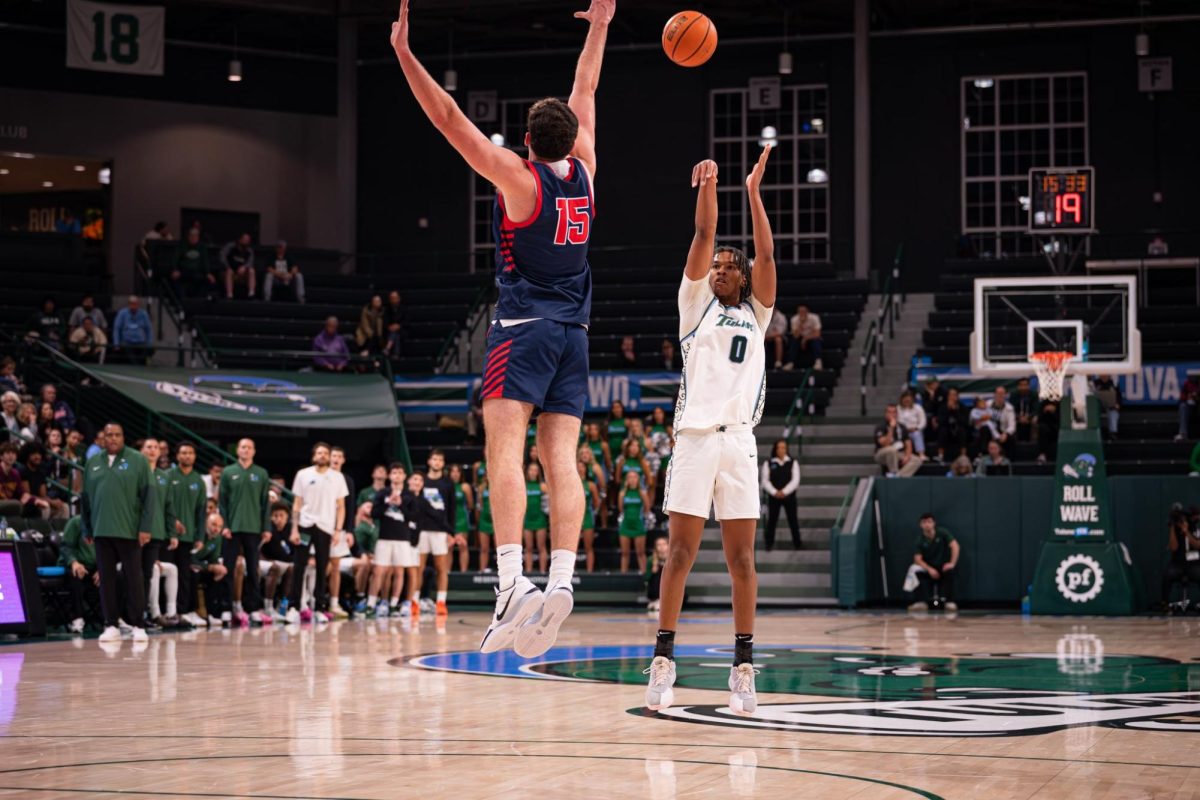
The Tulane University men’s basketball team is off and running with a hot 3-0 start in the 2025-26 season.
While every opponent the Green Wave has faced is different, they’ve all been scrappy. Here is one positive and one negative takeaway I have from the first three games of the season.
Positive: The emergence of Tyler Ringgold means more than people think.
Second-year Tulanian Tyler Ringgold was under the radar last season. However, with forwards Kam Williams and Kaleb Banks transferring in the offseason, keeping Ringgold was a huge sigh of relief for head coach Ron Hunter. The team has asked a lot out of him so far this season, and he has more than delivered.
Ringgold’s presence is evident throughout the entire game. Last season, he was a wiry, athletic wing and versatile defender, but he didn’t have much of an offensive repertoire.
That has drastically changed. Ringgold has developed his post game way more than I expected him to, and he’s also a decent threat from outside of the paint. He’s a great screener, and his defensive versatility has only grown since putting on more muscle. His energy is unmatched, and he gets into the other team’s head.
Can that mean he plays a little dirty sometimes? Yeah. But teams need that. Ringgold is a guy that you love having on your team and hate playing against.
Negative: The zone defense is wreaking havoc, but the defensive rebounding has to be better.
Hunter has been keen on running a zone defense ever since I can remember, which even goes back to his Georgia State University days when his son and current Tulane assistant coach R.J. Hunter hit a game-winning buzzer beater in the NCAA Tournament to beat Baylor University.
Rebounding out of Hunter’s defensive scheme is very difficult.
Players have to communicate more than they do in a man-to-man defense because they have to be aware of both the ball and their assigned zone on the court. They have to shift to the ball and find a person to box out instead of simply boxing out their matchup.
In their first three games, Tulane has recorded 78 defensive rebounds and given up 38 offensive rebounds. This means that for every two defensive rebounds they haul in, their opponent reels in about one offensive rebound.
Second chances are how teams build momentum. In order to compete with physical conference teams like the University of Memphis and the University of South Florida later in the season, they need to be more efficient at cleaning the glass.
They have been everywhere defensively, but once they give up an offensive rebound, they can be out of position, which leads to more scoring opportunities for opposing teams.
Tulane’s next game is Friday, Nov. 14, at home against the University of New Orleans, a team that beat them last season and won in an upset on the road versus Texas Christian University less than two weeks ago. If Ringgold keeps this up and they figure out their rebounding woes, look out.