

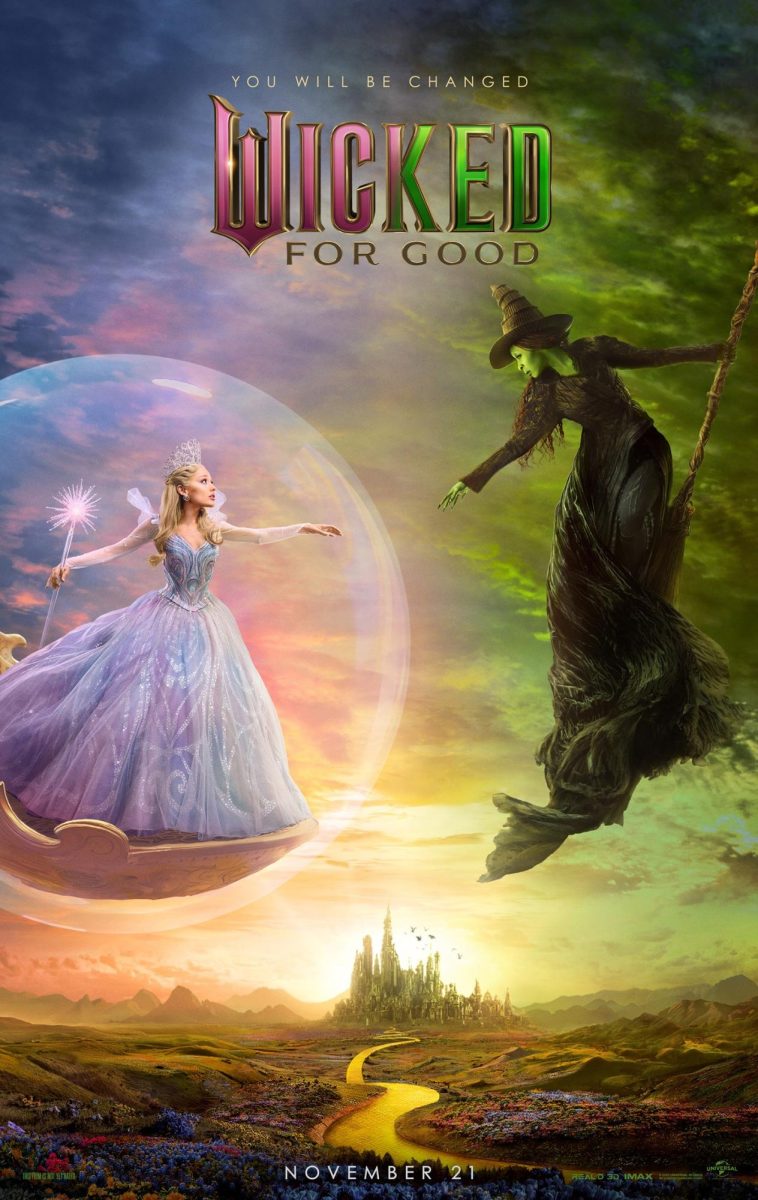
Director Jon M. Chu’s “Wicked: For Good” arrives with a built-in prerequisite — the film assumes you’ve either seen the “Wicked” movie or know the Broadway musical well enough to fill in the emotional and narrative gaps on your own. So if you’re not already fluent in the lore of the Wizards’ corrupt rise to power or Elphaba, played by Cynthia Evrio, and Glinda’s, played by Ariana Grande, fractured friendship, you’d better catch up. That expectation is bold and at times limiting, but also frees “Wicked: For Good” to dive immediately into its darker political terrain.
It’s clear that the land of Oz isn’t a whimsical fantasy anymore. Instead, it’s an authoritarian state constantly pumping out national propaganda. The Wizard, played by Jeff Goldblum, and Madame Morrible, played by Michelle Yeoh, intensify their campaign against Elphaba, hailing Glinda as the golden child of the realm. The film pushes the reality that Glinda isn’t powerful — she’s marketable and treats her image like a political brand, weaponized to distract from the corruption rotting Oz from within.
Glinda’s storyline remains one of the film’s strongest emotional anchors. Grande plays her with a vivacious, aching vulnerability — someone who desperately wants to do good but craves the applause more. Her engagement to Fiyero, played by Jonathan Bailey, feels more like a PR campaign than a romance, especially given that Fiyero’s heart belongs to someone else. Yet the film rushes through the emotional developments of the love triangle, asking the audience to fill in gaps the script doesn’t take time to build.
Compared to the first “Wicked,” the second film focuses more on Glinda, giving Grande added narrative weight with the new song “Girl in the Bubble” and glimpses into her past. While these scenes undoubtedly strengthened her character, they also make the uneven distribution of screen time more distinct. With more attention given to the sidelined animal subplot or development of character relationships, the film could have landed with a greater emotional balance.
Those pacing issues pop up again with the one-sided romance between Boq, played by Ethan Slater, and Nessarose, played by Marissa Bode. Their arc turns sharply, without enough time to land a satisfying finish. The film also made a thoughtful revision to Nessa’s story, specifically to her desire for physical transformation, but the actual change is handled so awkwardly that its emotional resonance falls flat.
One of the more clever but brief touches is a visual nod referencing the 1939 film, “The Wizard of Oz.” It’s a fun detail, but it is so fleeting and disconnected from the story that it lands more as a distraction than an homage.
The animal subplot, once a core metaphor for Oz’s oppression in the first movie, feels sidelined in “For Good.” Besides a few moving scenes, the film barely returns to the animals’ loss of voice and mass exodus from Oz.
Even with these stumbles, the film’s thematic core is undeniably strong. Oz is unraveling, animals are continuing to lose their voices, propaganda against Elphaba is surging and nearly every character becomes morally compromised. Chu reins in the spectacle to explore the question that has always haunted “Wicked:” Who gets to be labeled good? Glinda, Fiyero, Boq and Nessa all become both victims and contributors in Oz’s oppressive regime.
As Glinda becomes more entangled in the Wizard’s political machinery, the story locks into its tragic momentum. The film moves quickly through several departures from the musical, but its reimaging remains thematically compelling.
The final act delivers on the most satisfying emotional moments in the entire two-part saga, grounded by the reprise of the song “For Good.” Grande and Evrio make it tender, grief-filled and raw — a pause in a film that rarely allows itself to slow down.
By the end, Glinda’s journey feels more meaningful than performative. The film frames her rise to power as both a triumph and a reckoning for the troublemakers in Oz — showing that her goodness comes not from adoration but from choice. It’s the film’s most earned and satisfying character development.
Erivo brings the house down with her vocals, especially in “No Good Deed.” Her acting, though sometimes cringy, was effortless and left me wanting more. However, her shift from misunderstood outsider to the Wicked Witch felt abrupt and somewhat forced.
The casting was solid, but Yeoh stands out as a weak link. Her rendition of Madame Morrible falls flat with anticlimactic line delivery and a general lack of depth.
“Wicked: For Good” is far from flawless. It rushed through major emotional arcs and skimped out subplots, resulting in a more Glinda-centered Oz. Though not as cohesive as the first film, the finale delivered a meaningful and emotional farewell.