


Nestled in a warehouse in the Lower Garden District, the New Orleans Ballet Theatre is a studio for students and professional dancers alike. Now in the middle of their fifth season as a professional company, the directors, choreographers and dancers are preparing for the upcoming spring season.
NOBT was founded in 2002 by Gregory and Marjorie Hardwick Schramel to become the principal ballet company of Louisiana. Artistic director of NOBT Gregory Schramel said he hopes to make NOBT a traveling company.
“I think we are well-suited for [travelling to perform in] Baton Rouge, Lafayette and possibly Pensacola,” Schramel said. “You can drive there within three hours, and you can rehearse the same day. Financially, that is valuable.”
When founding his ballet company, Schramel made it a priority not to overwork his dancers, so he incorporated a 20-hour work week to accommodate the professionals’ stamina, other jobs and futures.
“The dance career is very short, so I think [this schedule] gives the dancers an opportunity to at least prepare themselves for their life after dance,” Schramel said. “I even want to get a grant to help teach dancers future skills.”
Some dancers have separate jobs from their dancing careers. At NOBT, many teach classes to the students of the ballet school.
Kaylin Wilson is one of the professional dancers at NOBT who teaches children’s ballet. In the classic holiday performance of “The Nutcracker” last month, she danced on stage with her students.
“I try my best not to distract the little ones because when they look [at me], they see their teacher all year,” Wilson said. “It’s really nice to see how they act in rehearsals versus class. I can see their wheels turning, [remembering] all those times that I told them to keep their wiggles in.”
The company has taken a break after the intense autumn season, in which they put on three ballets in the span of three months: “The Prodigal Son,” “Dracula” and, of course, “The Nutcracker.” “The Nutcracker” had more than twice the number of show dates as any other NOBT show.
“You really have to put forth your full effort into every single thing that you’re doing [during Nutcracker rehearsals],” NOBT Dancer Drew Lenore Pearson said. “There’s also a lot of specialness around the show. It feels very holiday in New Orleans and the atmosphere of ‘The Nutcracker’ is always one of festivity, cohesion and community.”
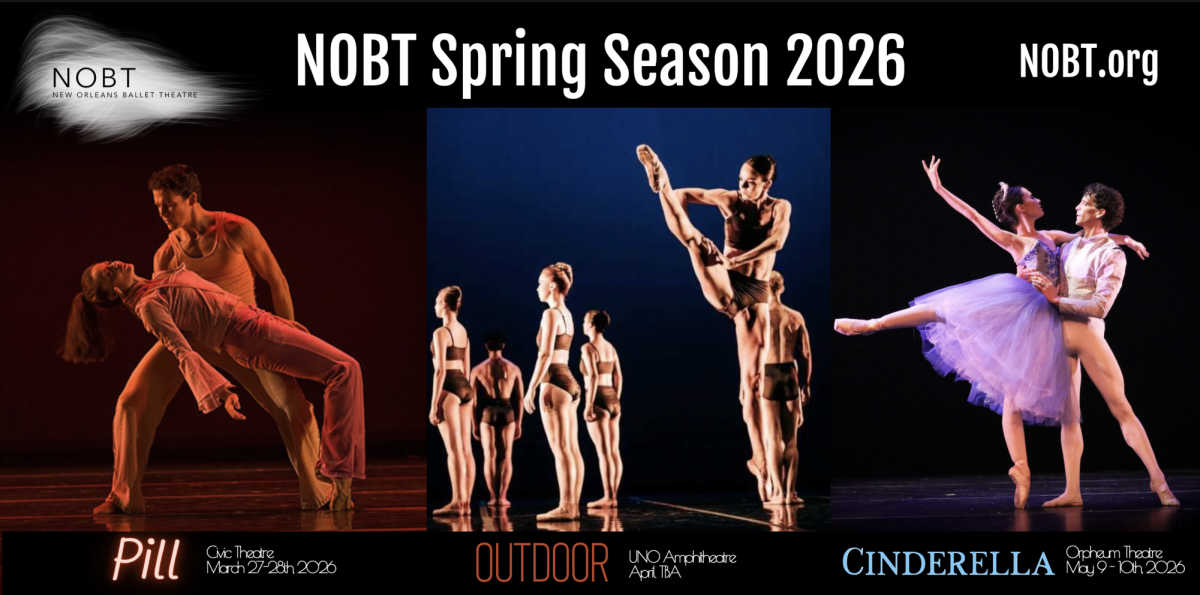
Now, NOBT is looking ahead to its spring season, a mix of originality and tradition, including “Pill” in March, free outdoor performances in April and “Cinderella” in May.
“Pill” is a piece created and choreographed by Schramel that takes place during the 1960s. Growing up in this decade, he witnessed the contrasting phenomena of nuclear fear and free love.
“It’s a look back at the two things that I think changed the world in really dramatic ways,” Schramel said. “That is, the ability to have sex without the consequences that people faced before was huge, and the ability for mankind to destroy itself was huge. I think [this ballet] really encompasses the zeitgeist of the time.”
This is the fourth year the company has put on free performances at the University of New Orleans’ Lakefront Arena, an outdoor amphitheater.
“Ballet tickets are expensive, so that’s a big step for someone to spend 50 to 100 dollars if they’ve never seen one,” Schramel said. “Also, people get to see that [ballet] is a living, breathing art form. That’s why it is generally new choreography, an opportunity for us to do original works.”
To finish the 2025-2026 season off, NOBT will be putting on a production of “Cinderella.” This piece tends to be lighthearted and comical, as companies often cast male dancers in drag as the Ugly Stepsisters who act as comedic relief.
“I’ve not done a ‘Cinderella’ production before,” Wilson said. “Our spring productions are always really good dancing, and I’m excited for the new steps.”
With “Cinderella” or any ballet that NOBT performs, there are multiple casts, and dancers have different roles depending on the cast. It is an unranked company, meaning all professional dancers are equal, sharing roles and working as a team.
“[The company] is very fun in that way, you get to do what you love with people you love that you can really feel on stage,” Pearson said. “That affects how you perform. You really want to show up and do your best for yourself, your company mates and for the audience, and from what I’ve been told, the audience can also feel that as well.”