

Once upon a time, C’s got degrees and our grandparents could afford houses by 30 years old. Now, it seems everyone is getting A’s and no one can get a job.
Grade inflation is when an overall increase in students’ grades is not coupled by an increase in achievement.
Yale University instructors called attention to the trend in the 1990s, raising concerns about what happens when “good” is placed at the same level as “excellent” and A grades are rewarded as participation trophies. In 2010-2011, 67% of grades awarded at Yale were A grades. Now that number is closer to 80%.
At Tulane University, students graduating this year need a 3.977 to be in the top 5% of GPAs in the class, which is less than one B over four years of classes.
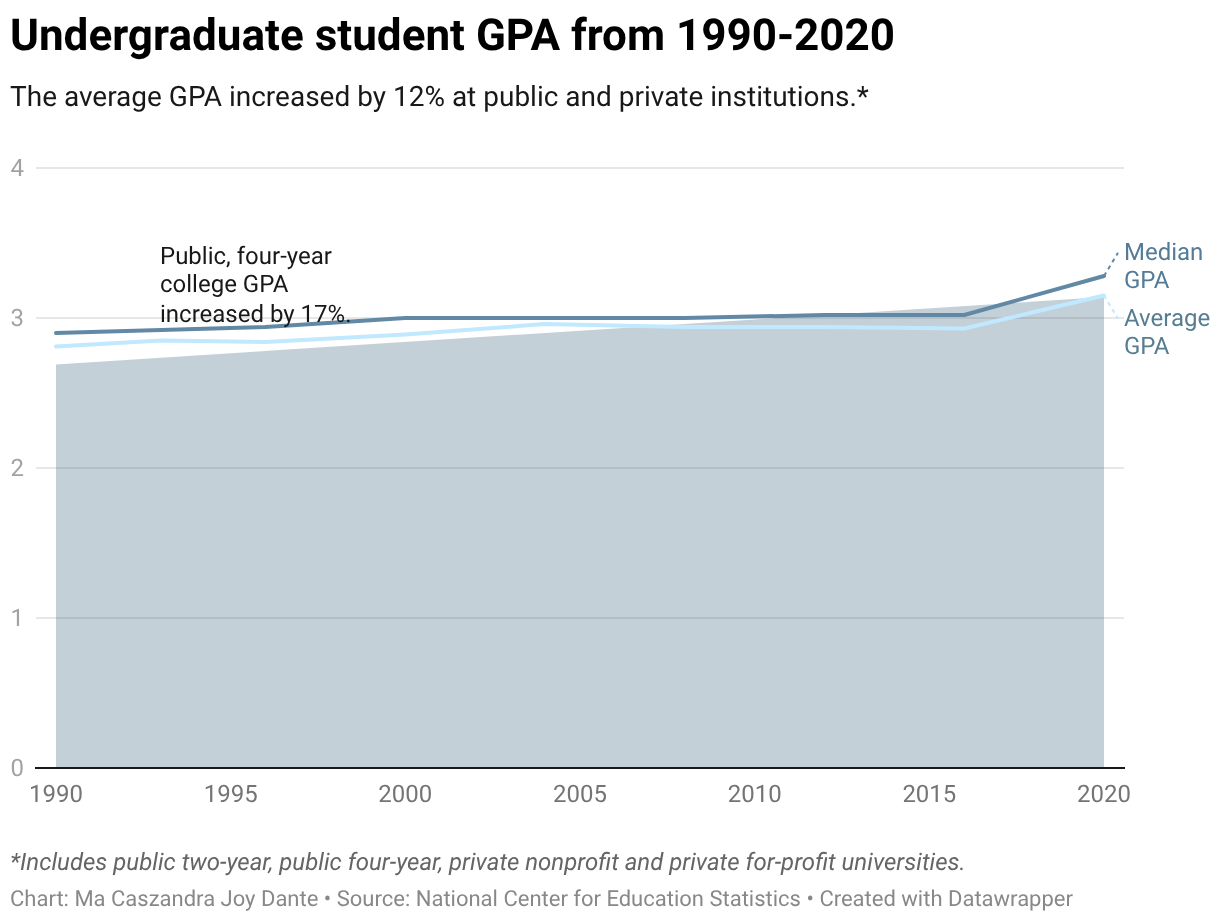
Paradoxically, the average increase in grades corresponds to a decrease in time spent studying. Full time students at four-year colleges spent 10 hours less studying per week in 2001 compared to 1961. And yet, student grade point averages have risen 0.34 points since 1990, an average GPA increase of 12%.
Supply, demand.
When the demand for good grades increases, so does the supply.
While students want high GPAs for graduate school and job applications, universities aim for high GPAs to appear high-achieving and increase retention rates. Hannah Frank, assistant professor of ecology and evolutionary biology, called the push for higher grades a “total co-evolutionary arms race.”
Grade inflation comes as university admissions are becoming increasingly competitive and prospective students are closely comparing schools and programs. Frank said students don’t want to be disadvantaged by attending a school with stricter grading policies.
Concurrently, with the emergence of course evaluations and sites like Rate My Professors gaining popularity, instructors may be negatively reviewed if a student feels they were graded unfairly. There is “a push to bow to student demands,” according to one Tulane professor of practice in the School of Science and Engineering who asked to remain anonymous.
Junior Eliana Masada said that the high cost of college attendance may contribute to student expectations of high grades. “You might be paying for your A’s,” Masada said. Tulane’s cost of attendance topped $90,000 this academic year.
Frank said the expectation that instructors grade easily can be limiting, as they cannot provide meaningful feedback when students expect high grades for simply doing what’s expected of them. She uses grades to evaluate student mastery of class material, rather than as a comparison to their peers.
The professor of practice said grade inflation could also be attributed to more lenient grading during the COVID-19 pandemic. She said that students have become accustomed to forgiving grading and feel entitled to high grades that don’t always “reflect an understanding of the course material.”
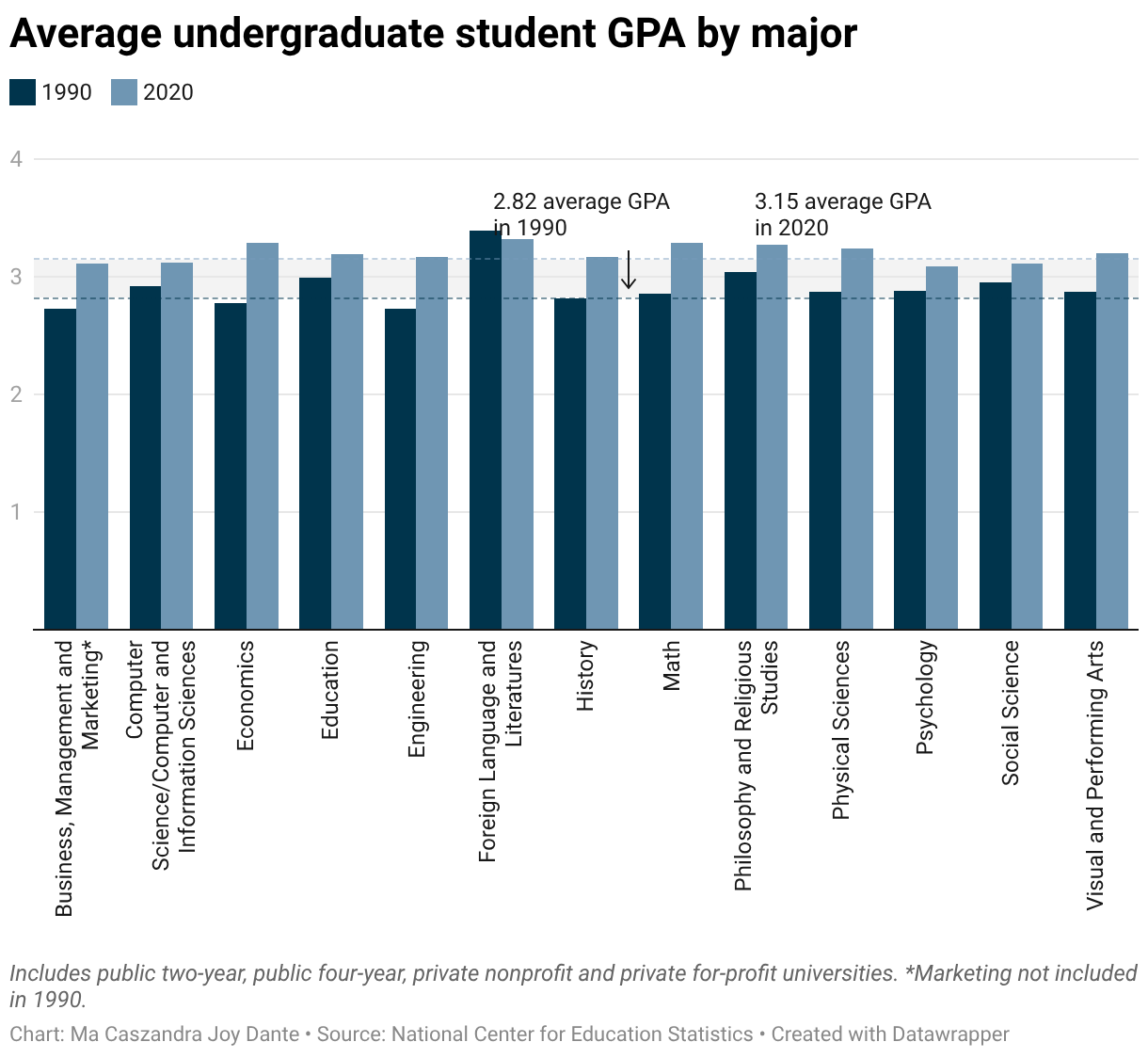
At universities nationally between 1990 and 2020, almost every field of study experienced an average GPA increase, according to data from the National Center for Education Statistics. The average GPA in 2020 was 3.15, up from 2.82 in 1990.
One study found that students chose to take courses and majors that are graded easier to boost their GPA, accounting for a quarter of the increase in grades between 1980 and 2001.
Another issue with grade inflation is inconsistency across fields. An A grade in an art class may not be equivalent to an A grade in an engineering class, yet the boost to the GPA is the same. At Princeton University, humanities students receive an A-plus half as often as students in the natural sciences. At Tulane, the A. B. Freeman School of Business has policies for what the average grade in the class should be, inflation-reduction measures that don’t exist in other Tulane schools.
Masada said such policies disadvantage students applying for graduate school or jobs who may have lower grades than other students because of departmental grading differences.
Despite the average increase in GPA, students are scoring similar scores on end-of-course exams as they have in years prior.
Loss of market value.
As basic economics dictates, too high a supply decreases the good’s value. Grades have increased, but their value has not.
At schools nationally, many awards such as the dean’s list, originally meant to reward outstanding students, have either had the minimum cutoff raised or lost their prestige as A’s become more common. Before Harvard University stopped publishing the dean’s list in 2002, 92% of upperclassmen received the award.
Tulane raised the dean’s list GPA requirement from 3.5 to 3.7 in 2021. Since then, the portion of students receiving the award has hovered around 40%, with 3,155 out of approximately 8,620 undergraduates being named last semester.
Jobs are also becoming less dependent on GPA to assess a student’s qualifications. Employers are shifting away from using GPA to review candidates, with less than 40% of employees screening for GPA in recent years.
Grade compression.
Some elite universities have released statements addressing the issue of grade inflation.
Some have argued that Tulane should establish an even scale between letter grades, with the opportunity to receive at A-plus to distinguish the highest achieving students. As it stands now, students can receive a B-plus or C-plus, but only an A. Elsewhere, faculty have advocated for “narrative-based” grading systems, like letters of recommendation and individual evaluations to better distinguish students.
A Texas bill proposed that class average grades be placed on student transcripts. An A-minus grade in an A-minus average class would hold equivalent merit to a B in a B average class, stressing a grade based on comparison rather than an arbitrary scale. Grading caps could also be adjusted by department through standardized test scores or average departmental grades.
Or there doesn’t have to be reform at all. One study finds that anti-inflation policies encourage students to switch to majors without the policies and lowered students’ opinions of their professors.
Sophia Finkbeiner contributed to the reporting of this story.