

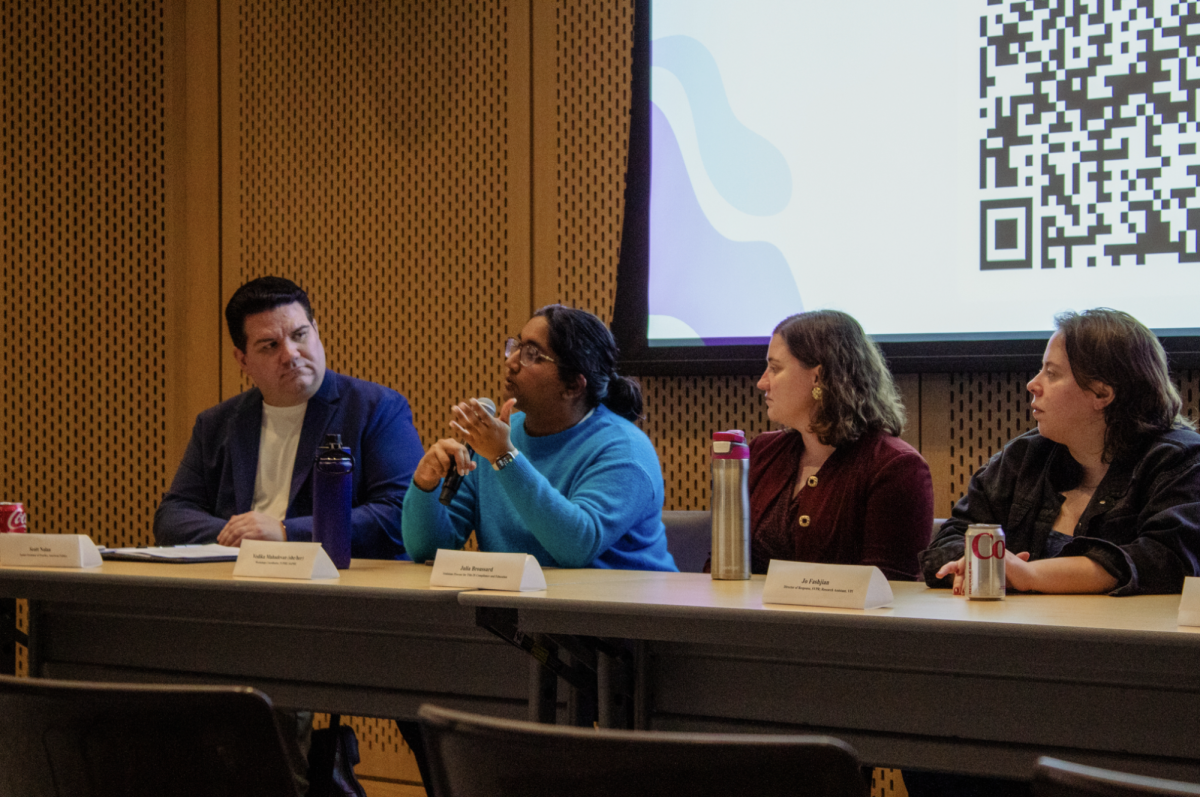
Tulane University’s Sexual Violence Prevention and Response Collective hosted its 10th annual Sexual Violence Town Hall on Feb. 3. Five panelists discussed campus sexual harassment resources and how the Trump administration has altered sexual violence response guidelines.
Anneliese Singh, chief officer for academic excellence and opportunity, was the keynote speaker at the event. She now leads the Office of Academic Excellence and Opportunity, formerly the Office of Equity, Diversity and Inclusion.
According to Singh, traditional university response procedures to sexual violence are built to manage risk, assign blame and contain liability.
“Too often, they leave survivors feeling invisible and communities broken,” Singh said.
Panelist and Chief Title IX Officer Julia Broussard referenced data from Tulane Sexual Misconduct Climate Surveys, an anonymous university study conducted every four to six years to assess campus sentiments on sexual violence.
According to the 2022 study, 29% of respondents experienced unwanted sexual contact since enrolling at Tulane. 83% of survey respondents strongly disagreed with the claim that sexual violence is not a problem at Tulane.
As a private institution, Tulane has more flexibility in determining how it handles sexual violence cases.
“I am incredibly grateful we are a private institution … LGBTQ folks are protected on this campus, and they will continue to be protected, kind of regardless of what’s happening at the federal level,” Broussard said.
Panelists also discussed Trump’s re-implementation of the 2020 Title IX regulations, which narrowed the definition of sexual harassment, strengthened due process for the accused and defined sex based on biology.
Broussard said the new regulations make it harder for students going through Title IX investigations.
Title IX is a federal civil rights law that prohibits discrimination on the basis of sex in educational institutions that receive federal funding, including private institutions like Tulane.
Panelists said that regulations like these lead to increased Title IX violation charges that target transgender students’ participation in sports or access to gendered facilities because they are used like “a tool to go after schools that [the Trump administration] see as providing access primarily to trans and non-binary folks,” Broussard said.
Panelist and SVPR Director of Response Jo Fashjipan also addressed the misconception that sexual violence is a woman’s issue, “when that’s not the case at all,” Fashjipan said.
Nearly one in four men experiences some form of contact sexual violence in the U.S. in their lifetime.
“The president, for example, is a key informer of what masculinity has meant in America,” Scott Nolan, political science senior professor of practice, said. “We have a conservative Republican administration … who constructs masculinity as a transactional situation with women.”
SVPR strives to unite Tulane’s campus through violence prevention and sexual education. The collective hosts weekly Wednesday meetings from 7 to 8 p.m., where they plan events and discuss prospective All In grants, which are grants for Tulane students interested in hosting programs and initiatives to promote sexual health and safety.
According to Baileigh Evans, assistant director of health promotion at The Well for Health Promotion, education and motivation for change can be encouraged through “healthy peer pressure.”
“You have the power; that’s how peer health education is so important on this campus,” Evans said.