


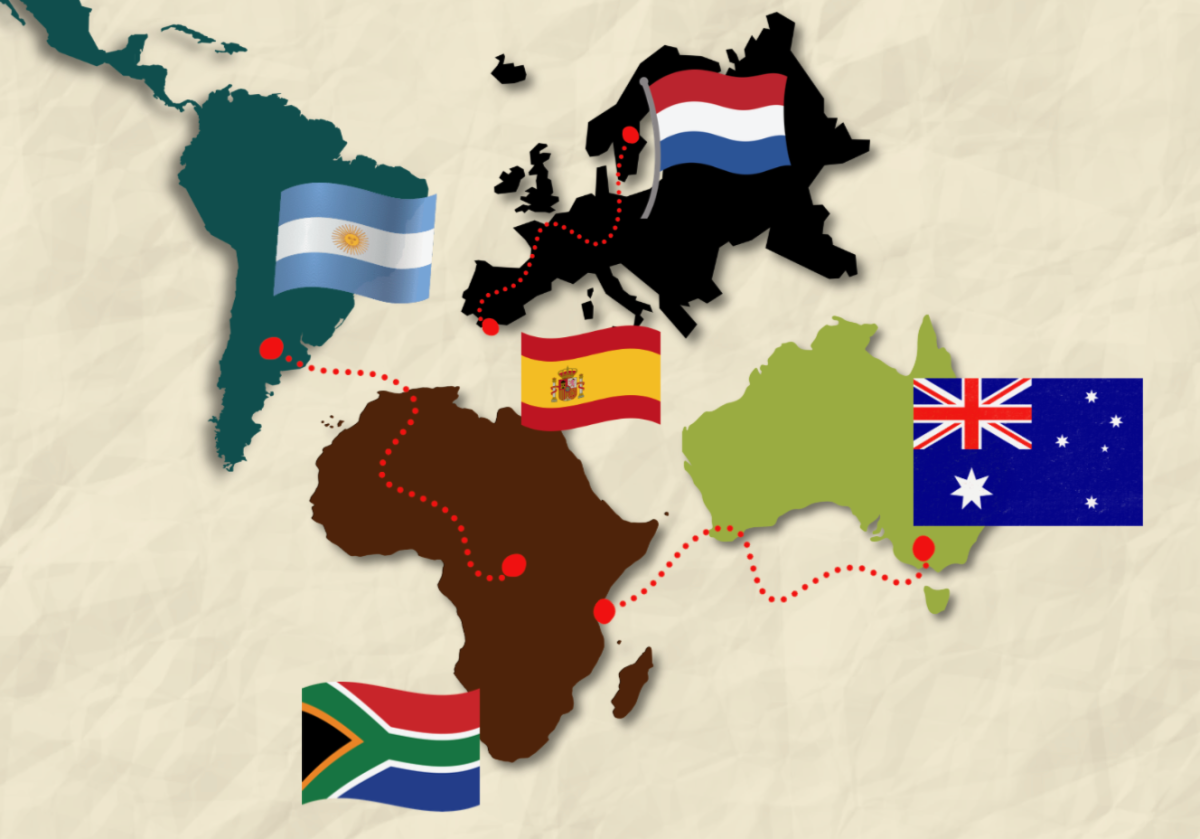
Tulane University is bustling once again as hundreds of juniors returned from study abroad programs spanning six continents, filling campus with a global energy and a surge in foot traffic as the spring semester kicks into high gear.
Tulane’s Office of Study Abroad sends approximately 800 students around the world each year to 172 programs in 51 countries. With so many locations to choose from, it can be overwhelming to select just one — this guide has all the information you need to decide.
Sydney, Australia:
Choosing Sydney as a home base brings students halfway around the world, far removed from their peers in Europe, to a city that offers beautiful beaches as well as an urban environment.
Junior David O’Toole spent his fall semester in Australia. “I wanted a unique experience. I was really drawn to Australia because of the nature, the beaches, the rainforest, the unique wildlife that it has to offer.” O’Toole said.
The culture was another factor that drew O’Toole to Australia. “Australians are super nice people. Everyone’s very chill, pretty laid back, it’s a very easy-going place,” O’Toole said.
One challenge O’Toole acknowledged was how isolated Sydney is, compared to some European cities where other destinations are a short train ride away.
“Whenever you travel somewhere, whether that’s a different part of Australia, New Zealand, Thailand or Southeast Asia, you’re going four to eight hours on a plane,” he said. “Planning ahead and buying plane tickets early is important because prices will go up.”
Madrid, Spain:
Madrid, a bustling city with vibrant nightlife, is a very popular study abroad location that typically reaches program capacity.
Junior Heeral Lenka said one of her favorite aspects of having Madrid as a home base was its location. “It was very central, so it was easy to get to other countries and cities.”
Lenka studied business at IE University in Madrid. “I had a really easy semester, and I was mostly just having lots of free time and traveling … I was never stressed about school,” she said.
One drawback was the price. Lenka said that Madrid was a very expensive and metropolitan area. “Madrid is very much like the New York City of Spain,” she said.
Seville, Spain:
Seville is the perfect location for students wanting to escape the tourism and international social scene of larger Spanish cities, instead focusing on interacting with the local culture.
Junior Liviya Larman worked on her Spanish minor in Seville. “I met a lot of great people [in Seville] … for the program that I did, I got a lot of opportunities to get involved with the local culture,” said.
Larman chose to spend her fall semester in Seville rather than Barcelona or Madrid because she wanted to “speak Spanish more in [her] day-to-day life.”
“The only con would be that traveling is just a bit harder, because you’re a little bit more removed and the airport’s smaller,” Larman said. “Overall, I think it was worth it … It’s such an awesome city.”
Buenos Aires, Argentina:
Spending a semester in Buenos Aires is ideal for students who want to completely escape the “study abroad bubble” and push their comfort levels and linguistic abilities.
Izzy Epstein was attracted to the language immersion aspect of having a home base in South America. “I had three classes, and they were all in Spanish,” she said. “I had an internship … that was probably the heaviest of my workload.”
While students who spent a semester in Europe recommended saving between $8,000 to $10,000, Epstein said she spent less than $6,000.
Epstein said going “anywhere in South America … is a good opportunity to push yourself.”
Florence, Italy:
Florence is a small and compact Italian city, known as the birthplace of the Renaissance and recognized as a UNESCO World Heritage Site for its artistic value.
Krya Schechter, a senior at Tulane, reminisced on the “sense of community” she found studying abroad in Florence in the fall of 2024.
“It’s a very small city, which I liked because I felt like I got to know it really well. I had my local restaurants and cafes that I would go to every morning, and I got to know the people working there.”
Schechter said that Florence’s lack of a major long-haul airport — in contrast to the international hubs in Milan and Rome — presented some logistical hurdles for weekend travel.
“The con for me about Florence is that it is a little hard to get in and out of … it made it harder to go visit friends or have other people come visit me,” Schechter said.
While she did travel about every other weekend, “There’s so much to do [in Florence]. I think I could have spent every weekend there and I wouldn’t have been bored,” Schechter said.
Amsterdam, The Netherlands:
As a city of about one million people, Amsterdam is a very unique and culturally liberal home base location.
Ella Ruhl, who spent her fall semester in Amsterdam, found the bluntness of the Dutch people to be a large culture shock. “If you were having a bad hair day or something, they would be like, ‘Wow, you’re looking really tired today,’” Ruhl said. “Biking was my form of transportation … [the locals] would curse you out or go around you if you’re going too slow.”
In terms of location, “It was very central to a lot of places that I wanted to go. It was really easy to take buses to and from places,” Ruhl said.
Nestled in Western Europe, the city is close to the United Kingdom, Germany and Northern France, offering different travel opportunities than those for students who study abroad in southern Europe.
Ruhl said a negative of Amsterdam was the lack of sunlight. “For the first few weeks I was there, it was really colorful and beautiful,” she said. “It started to get really dark and gloomy … [the city] felt a little bit dead by the time it was October.”
Cape Town, South Africa:
Choosing Cape Town as a home base exposes students to a unique society, encouraging exploration and independence as opposed to studying in more traditional European destinations alongside other Tulane students.
“It was me and one other person from Tulane in my program that I didn’t even know beforehand and it really encouraged me to branch out and meet new people,” Cat Sands, a junior studying anthropology, said.
Students heading to Cape Town should know they are signing up for a rewarding but remote semester. “It does get a little isolated, geographically and socially,” Sands said.
Regardless, Sands was very grateful for how the experience pushed her beyond familiar routines.
“There’s so many things there that you wouldn’t get the opportunity to do in New Orleans especially,” Sands said. “There’s lots of nature, hiking and surfing and a lot of cultural differences that are really important and exciting to learn about.”
Mike • Feb 5, 2026 at 6:43 am
Taiwan