


This piece contains discussions of violence, including school shootings.
House Bill 99, introduced by Rep. Danny McCormick, in the Louisiana House of Representatives, allows any 18-year-old on any public college campus, or private institution that receives state funding, to carry a gun on campus.
McCormick argued that students should be able to protect themselves on college campuses, and carrying a gun freely is part of that. “Evil doesn’t respect ‘gun-free zone’ signs,” he said in an op-ed in The Hayride.
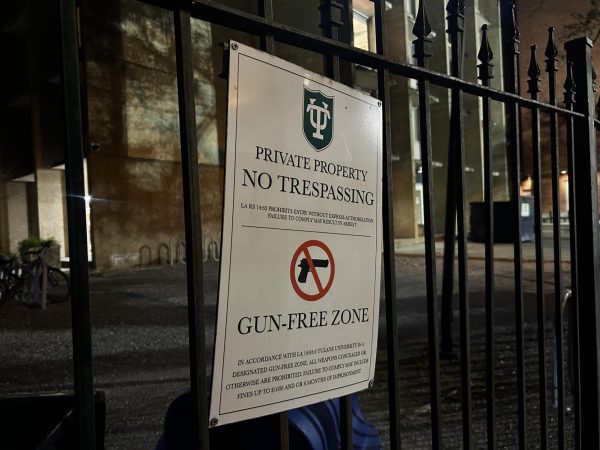
But HB99 arms the problem instead of solving it.
Most college and university shooters have a connection to the campuses they target. They also tend to be undergoing some form of crisis at the time of the shooting.
During college, students are put under enormous stress. Many college students are sleep-deprived, stressed and academically overwhelmed. These are not conditions under which anyone should be carrying a loaded weapon. Imagine a student walking into a packed classroom armed, then receiving a failing grade. The outcome rests entirely on that student’s judgement.
Now consider the heavy drinking and recreational drug use which remain a defining feature of college social life. As of Feb. 23, TUPD has logged 215 calls, with 166 of those being on Tulane’s Uptown undergraduate campus.
Many of these calls are serious, but they are rarely deadly. Introducing firearms into that environment raises the stakes exponentially. A drunken argument outside a dorm does not need to end in a life lost. When guns are readily available, ordinary lapses in judgment have potential to become irreversible tragedies.
More guns means more chaos. In a crisis situation, law enforcement arriving on scene may not be able to instantly distinguish between a shooter and an armed student attempting to intervene. Split-second decisions by first responders may be made in confusion. Introducing dozens of firearms into that equation just complicates it further.
There is also the academic mission to consider. Universities are meant to be spaces of debate and disagreement. Students argue about politics, religion, identity and morality, while professors challenge assumptions. The presence of openly carried firearms changes the psychological environment of these spaces. It is difficult to foster open dialogue when the person disagreeing with you is visibly armed.
Gun-free zone policies alone may not stop someone who intends to do harm, but it does shape a campus environment. Speed limits do not stop every reckless driver, yet we do not remove them when they are not followed. We create guardrails because they reduce risk, not because they eliminate it entirely.
HB99 asks campuses to accept heightened risk in exchange for a promise of hypothetical protection. It assumes perfect judgment from 18-year-olds in imperfect circumstances. It assumes that escalating force de-escalates conflict. It assumes that more weapons equal more safety.
Those are dangerous assumptions.
If the goal is truly to reduce violence, then investment in mental health services, crisis intervention and campus safety would address the root causes of campus violence. Increasing access to firearms does not treat these crises. It only ensures that when those pressures boil over, the consequences are deadlier.
Joseph Horton • Feb 26, 2026 at 10:51 am
Has the author examined the results of campuses on which firearms are allowed? Do they think Tulanians are less responsible?