


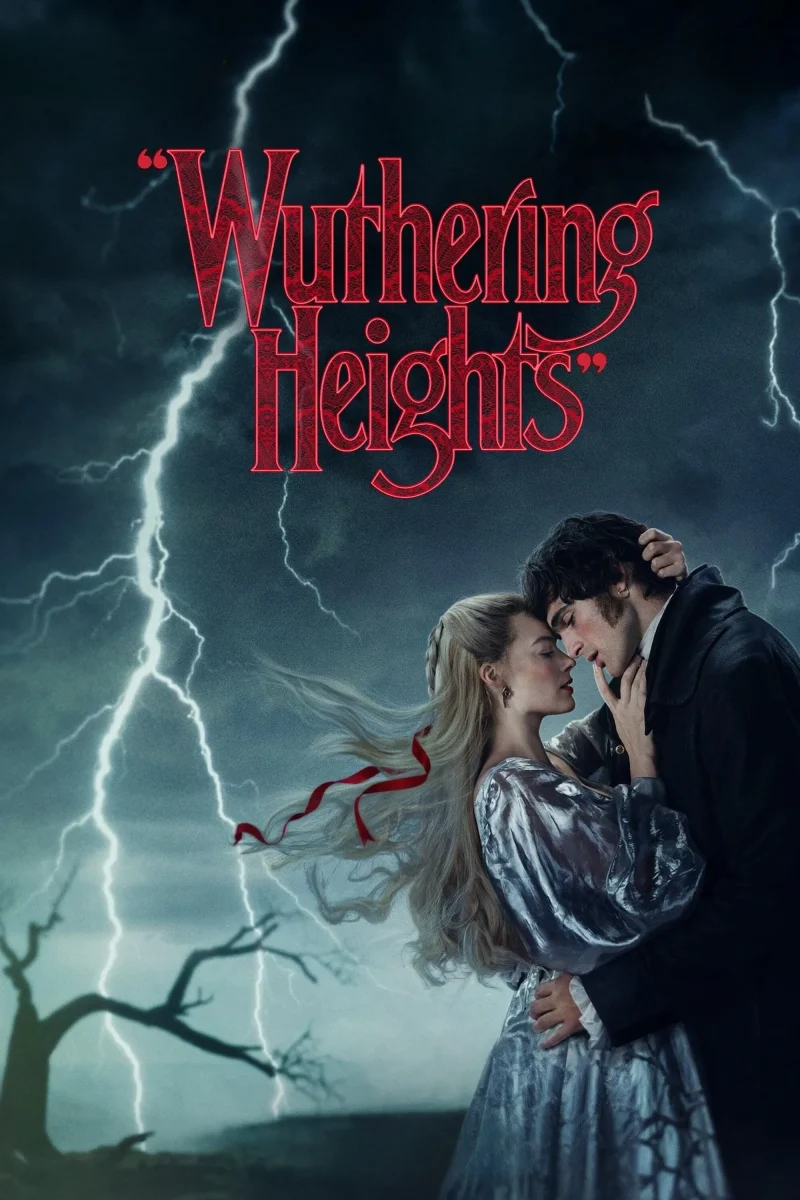
For any lingering Valentine’s Day feelings, you can sit back — but maybe not relax — and watch Emerald Fennell’s “Wuthering Heights.” A film adaptation of British author Emily Brontë’s 1847 romance novel of the same name, “Wuthering Heights” is less intriguing but more visceral than its source material.
Catherine “Cathy” Earnshaw, played by Margot Robbie, is torn between two lovers: her adopted brother and lifelong friend Heathcliff, played by Jacob Elordi, and wealthy velvet merchant Edgar Linton, played by Shazad Latif. Between their childhood home, Wuthering Heights, and the Linton-owned Thrushcross Grange, Catherine and Heathcliff struggle to satisfy their mutual love without endangering themselves and those around them.
The aesthetic of the film is strikingly surreal and Baroque. Each room in Thrushcross Grange is saturated with different colors, while the vast land between it and Wuthering Heights is covered by thick fog.
Composer Anthony Willis’ soundtrack is captivating. Charlie XCX’s original songs are heavy, electrifying and otherworldly — a nice accompaniment to the characters’ surreal world.
Ellen “Nelly” Dean — played by Hong Chau — controls the narrative in a more interesting way than in the novel. The film lacks Nelly’s frame narrative from the novel. However, she is the only character in the film who gazes directly at the viewer in a brief scene. This suggests that her eyes are still the ones through which we see the story.
While prevalent in the novel, religion appears differently in the film. The sale of toy “sinners” follows a public hanging in the intro scene and signals the characters’ enjoyment of taboo. Joseph — played by Ewan Mitchell — is no longer god-fearing and preachy, but hedonistic. Heathcliff appears Christ-like early on, and later, his admirer Isabella Linton — played by Alison Oliver — wears a cross around her neck as he seduces her.
Fennell’s “Wuthering Heights” is reminiscent of Ryan Murphy’s work, such as the carnal Netflix series “Monster.” Zillah, played by Amy Morgan, is a family servant who enjoys BDSM with an unlikely partner. Lavish feasts top the Lintons’ dining room table, and a close-up shot of rolled dough and its moist sounds arouses Catherine. Edgar Linton makes the walls of Catherine’s room the same color as her skin, including her blemishes and moles.
Sadly, the visceral experience of the film comes at the cost of the characters’ development. Since the aesthetics of Wuthering Heights and Thrushcross Grange are so unsettling, some familiar characters are more appealing contrasts, while others, like Heathcliff, feel static. Viewers may become attracted to him too quickly, whereas in the novel, he is a powerful and unsettling force that readers and characters beware.
Jacob Elordi’s casting as Heathcliff has been a major source of criticism. The novel describes Heathcliff as a “gipsy” and “black” and also speculates that his father is an “Emperor of China” and his mother “an Indian queen.” Elordi does not resemble Brontë’s Heathcliff, leading some to argue that the film whitewashes the story.
The film has also been criticized for its anachronism and eroticism, which are not only disturbing but a poor substitute for the nefarious and creative revenge narrative in Brontë’s novel. “But you really don’t need to be accurate. It’s just a book. That is not based on real life. It’s all art,” casting director Kharmel Cochrane said in response to such critiques.
Fennell’s wealthy upbringing may bear its mark on her art. Purposeful inaccuracy is fine, but it cannot excuse a lack of compelling characters. In the case of “Wuthering Heights,” the art needs more life.
Favoring excess over austerity, Fennell’s “Wuthering Heights” has a different spirit than Brontë’s novel. The novel’s narrator, Lockwood, says, “They [Catherine and Heathcliff] are afraid of nothing.” But they might be afraid of this film. It is a ghost of their story.