

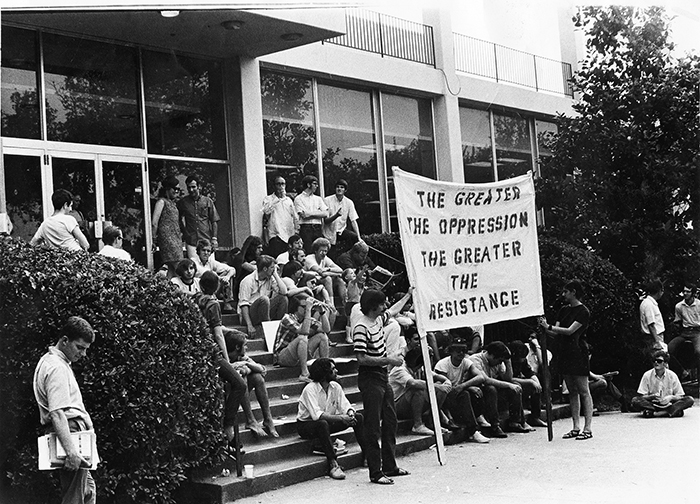
On May 5, 1970, Tulane University’s Berger Family Lawn filled with well-dressed young adults. Students assembled plywood coffins and draped them in black blankets painted with peace signs. Some began digging shallow graves to lower the caskets.
It was a memorial for the anti-war protesters killed at Kent State University.
Archived footage shows tensions rising as members of the right-wing group Young Americans for Freedom and the JROTC confronted the protesters.
This is not the first time a Hullabaloo writer has reflected on this footage of a bygone era.
Views editor Cullen Fagan wrote in 2020 that despite tensions with Iran, a national anti-war movement was nowhere to be found on college campuses. Fagan’s article followed the assassination of Iranian Gen. Qasem Soleimani by the Trump administration. This was the first time I began to question the “international police” narrative of America for the first time.
But the 1960s and ‘70s were simply different times.
The “New Left” dominated the youth culture, and the military draft mandated young Americans to give up their lives to interfere with another nation’s affairs and sovereignty. Socialist ideals were in vogue. There were active groups on Tulane’s campus such as the “Tulane Liberation Front” and a chapter of the original Students for a Democratic Society.
Now, there is no active military draft. We have not been attacked on U.S. soil. Regardless, the war with Iran has low approval at just 41%.
Still, where are the large protests on campus?
For one thing, student activists are exhausted. Nearly two years ago, student activists participated in an encampment protesting the United States’— and Tulane’s — complicity in the bloodshed of Gaza. Little came of the encampment. Tulane never divested from companies who have financial interest in Israel and endless war, just as it did not divest after a climate protest years earlier.
This encampment was one of many instances in the nation-wide “Gaza Solidarity Encampment” movement, which drew inspiration from a shantytown built on campus by the Tulane Alliance Against Apartheid protesting investment in South Africa in 1988.
The simplest criticism of the encampment for Palestine is that it was ineffective. This assessment is incorrect, and stems from a myopic view of history as merely a chain of direct cause and effect.
This movement was fundamentally anti-war in character. Even though the U.S. did not technically declare war, it bankrolled Israel, and now thousands are dead and millions displaced.
Tulane’s lack of response to the encampment was clear: Money from the war machine is even louder than the chants of protesters.
Exhaustion is one thing; an outright lack of motivation is another. The attitude of Tulane’s student body towards protest seems to be apathy and dismissal, which seems to me to stem from a general sentiment that the war is a problem “over there,” that it does not affect us.
For students who do want to speak out, Tulane’s campus is incredibly “chilled,” as indicated by its “F” free speech climate grade by the Foundation of Individual Rights and Expression.
The rate at which war with Iran was initiated was dizzying. The second Bush administration took over a year of manufacturing consent, gathering an international coalition and spreading the lie that Iraq had weapons of mass destruction before putting boots on the ground.
For these reasons, the 2003 anti-Iraq war protests were some of the largest in history.
Today, Trump initiated decapitation strikes mere weeks after Iran slaughtered thousands of its own protesting citizens. The rationale was that the United States will be “greeted as liberators,” and indeed many Iraqis in 2003 felt similarly initially.
This is false, and Iran’s most vocal dissidents have said that bombing their country will not bring the fall of the Islamic Republic. It will only strengthen the resolve of the Ayatollah’s supporters, kill thousands of more people directly and indirectly and leave behind another Iraq or Afghanistan.
But before that happens, everything will be more expensive, and the prices may not fall back to pre-war levels until 2027. But it shouldn’t require a change in gas prices to change someone’s mind. We are privileged with access to so much history demonstrating the effects of war, so why must we repeat it?
Anti-war protests may seem ineffective, and we may feel uncertain. Most progressive movements were seen unfavorably by the public, until the students were proven right.
So, the course of action is the same. We must put pressure on the Trump administration to stop the war and continue to pressure Tulane to divest from the oil companies that are the only entities to benefit from it. The data says we, the people, do not want this war. So, I implore us all: Bring the anti-war movement back.
Sad Citizen • Mar 27, 2026 at 12:19 pm
More antisemitic drivel: “ Money from the war machine is even louder than the chants of protesters.” WHEW HEW, let’s support those who want to drive the Jews out of their homeland, and not let that evil cabal of Jewish power-brokers control our government! Millicent Helmka and her compatriots in hate need to understand that purveying offensive and hurtful stereotypes damages our cohesion as a society and is against the values we hold as Americans.
Marcus • Mar 20, 2026 at 5:55 pm
Excellent article! Thank for breaking the constructed silences at Tulane about Palestine and the Iran war.