


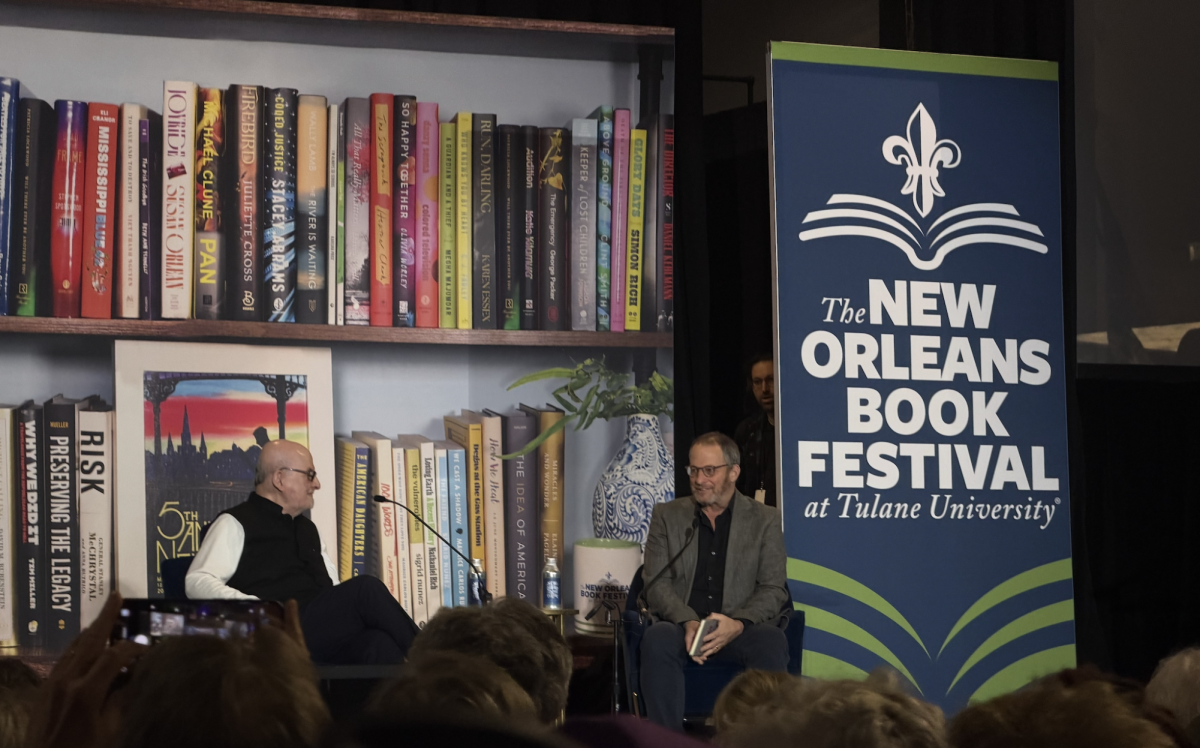
Novelist Salman Rushdie spoke to New Orleans Book Festival attendees Friday morning in a talk moderated by foreign policy journalist George Packer.
Rushdie is the author of 23 books, most famously the Booker Prize-winning “Midnight’s Children” and “The Satanic Verses.” His more recent works, and the subjects of Friday’s talk, include “Victory City,” “The Eleventh Hour” and his memoir “Knife: Meditations After an Attempted Murder.”
The last work concerns his 2022 stabbing by a religious radical that resulted in the loss of his right eye. Packer began the talk by mentioning the attack, though Rushdie did not linger long on the subject. He noted that the publication of his novel “Victory City” in 2023 helped him to do just this at a larger scale, reminding people that “there’s a creative writer here, not just a scandal or a victim of terrorism.”
Later in the talk, Rushdie cited the process of writing his memoir “Knife” as the thing that allowed him to resume his prolific literary output, even with the lingering trauma.
“At first it was unbearable to write, and then it was almost unbearable not to write … it was not possible for me to deal with anything else until I dealt with this,” Rushdie said.
Rushdie’s workman attitude towards writing emerged as a theme of the talk: Writing is, for him, a job he must do that the other parts of his life are in service of. He spoke about the diverse influences that fed into his most recent publication, “The Eleventh Hour,” which included paintings by Spanish artists Francisco de Goya and Hieronymus Bosch, an unfinished work by Franz Kafka about a trip to Oklahoma and tales from the Indian epics told to him in his youth.
The collection also features a ghost story and two revenge tales, genres that Rushdie has not historically dealt in. “What’s going on here with revenge? Why would I want to think about revenge?” Rushdie said rhetorically, drawing laughter from the audience.
When Packer asked him about his influences in the literary realm, Rushdie named Kafka, Mikhail Bulgakov, Charles Dickens, J.R.R. Tolkien and Latin American writers in the magical realist tradition, such as Carlos Fuentes and Gabriel Garcia Marquez. His favorite works, he said, “[create] fiction that is more interesting than the facts.”
The conversation also addressed free expression and the rise of self-censorship‑ among younger writers, particularly around fears of cultural appropriation. “Without appropriation there is no art,” Rushdie said. “If you can only write about the thing that you are, that’s such a tiny piece of human experience that you run out of it quite quickly.”
In the last minutes of the talk, Packer inquired about Rushdie’s upcoming projects, to which he replied that his next work will center on a woman living four thousand years ago in ancient Sumeria, who was the first person to sign her name to a piece of writing.
“You’re saying nobody reads books anymore. Even the intellectuals write essays about the death of the author. I thought I’d write about the birth of the author.”