



A new study led by Tulane University researchers found a link between exposure to wildfire smoke in the third trimester of pregnancy to an increased risk of autism spectrum disorder.
The lead researcher of the study, David Luglio, a postdoctoral fellow at the Tulane University School of Tropical Medicine and Public Health, studies environmental health and air pollution.
“We saw [wildfire smoke] effects … primarily in the third trimester,” Luglio said. “The brain basically explodes in size and formulates folds and stuff like that [in the third trimester], which really goes forward with finishing out the organization of the brain.”
Autism spectrum disorder is a neurodevelopmental disorder that affects social interaction, learning and behavior. Physicians usually diagnose ASDs before a child turns two years old.
ASD diagnoses have increased 300% in the past 20 years, with a 10-20% increase every two years, according to the Centers for Disease Control and Prevention. Approximately one in 31 children is diagnosed with an autism spectrum disorder.
“Development of [autism spectrum disorders] is multifactorial at this point, where maybe a genetic component is a huge part of it, but … evidence shows that [there are a lot of] environmental factors,” Luglio said.
Luglio said an increase in awareness, testing and accessibility, as well as various environmental factors, such as air pollution and nighttime temperatures, partially contribute to rising ASD rates.
Particulate matter, or PM, is any solid particle that enters the body and the inferior regions of the lungs. Luglio said that not all PM is created equal, and it’s important to look at the components and sources of the PM.
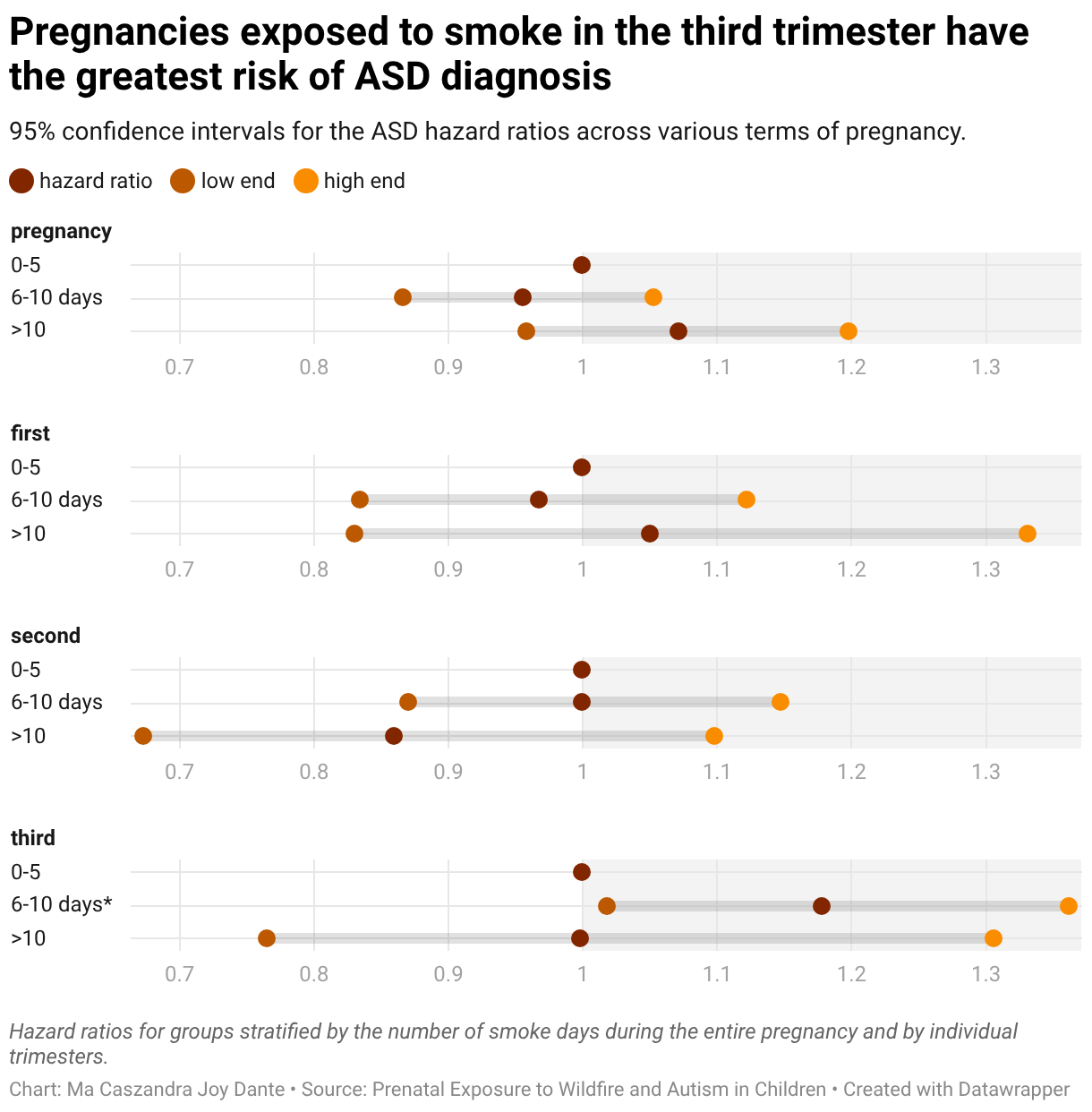
The study focused on mothers in California and diagnoses of autism spectrum disorders within the first five years of life. It found that wildfire PM has minimal effects on the first and second trimester but significant effects on the third trimester.
In Luglio’s study, the greatest association to autism spectrum disorders was found in exposure to wildfire PM concentrations greater than three micrograms per square meter, especially when the number of days exposed to the PM was higher.
The results suggest there is a “window of susceptibility” for autism spectrum disorders late in pregnancy, the study authors said.
Luglio said that one to five days of wildfire PM exposure led to an 11% increased risk for autism spectrum disorders, while six to 10 days saw a 12% increased risk.
More than 10 days of exposure were associated with a 23% increased risk compared to mothers not exposed to wildfire smoke.
Wildfire smoke also has toxic compounds that can lead to decreased birth weights and neurocognitive disorders.
Luglio said his team conducted the study in California, where wildfires such as the Palisades Fire “increase in frequency and severity” over time, influencing ASD rates.
Luglio also linked high stress levels to ASD, proposing that wildfires can cause stress, which could affect the fetus. Older mothers are also at higher risk of having a child with ASD.
Factors such as low birth weight and preterm birth are associated with ASD, though researchers have not yet found any causal relationships between them.
“Maybe… wildfires cause preterm birth, which then causes autism. You know, it could actually be all in one pathway,” Luglio said. “[Or] it could be several pathways.”
While exposure to wildfires during pregnancy can increase the risk of ASD, “mechanistic toxicological studies” are needed to definitively link ASD and wildfire smoke exposure, Luglio said. He suggested examining the chemical components of smoke particles and finding specific associations with developmental milestones in the third trimester.
“We just know that there is an increased risk due to air pollution exposure. Whether those go hand in hand with the rising rates [of ASD] or not, is beyond what we can tell at this moment,” Luglio said.