


Artificial intelligence use may have negative effects on brain activity, according to a new study by the Massachusetts Institute of Technology Media Lab.
The study tested the brain activity of participants writing an essay, with test groups asked to write the essay with either OpenAI’s ChatGPT, Google’s search engine or nothing at all. As AI becomes increasingly integrated into education, the findings suggest that the way students use these tools may have measurable cognitive effects.
The study found that participants who relied on AI to write essays had the lowest level of brain activity when measured with electroencephalogram scans, which measure electrical brain activity.
The ChatGPT group “consistently underperformed at neural, linguistic, and behavioral levels,” according to the study authors. They were also shown to have the lowest levels of neural connectivity, most notably in areas associated with memory, creativity and executive function
The study has some notable limitations. It has not yet been peer reviewed and had a small sample size of only 54 participants. The findings suggest a potential link between AI use and reduced cognitive engagement, but do not establish causation.
However, the researchers believe it raises important questions about how reliance on AI will influence cognitive growth and engagement in educational settings, and chose to release the paper before the peer review process, which can take several months.
Nicholas Mattei, an associate professor of computer science, said the broader concern is not whether AI reduces effort, but how it affects long-term thinking skills.
Tulane University’s Benjamin Deen, assistant professor of psychology, said that using AI for writing will affect learning and requires different cognitive demands than writing without it, because students engage less meaningfully with content when using AI.
“We don’t need a neuroimaging study to tell us that,” Deen said. “Ultimately, if you use AI language models to generate an essay on a topic rather than write from scratch, you should expect to learn less from the assignment. In this way, using AI is not different from conventional plagiarism.”
Similar concerns have arisen from a 2025 study published in Harvard Business Review that showed that the cognitive effects of repeated AI usage extend into the workforce.
The study found that while generative AI tools can improve productivity and output quality in some cases, they may also reduce intrinsic motivation and increase feelings of boredom. Researchers suggested that this may occur because AI often takes over the most cognitively demanding parts of completing a task, which limits opportunities for deeper engagement and problem-solving.
However, Deen said that AI can still be used positively in academic settings.
“There are constructive and non-plagiaristic uses of AI as an information source,” he said. “For instance, if allowed by course policy, you might use AI to research a topic by asking for a summary of what is known about the area, or requesting references for further study.”
The issue is becoming an increasingly hot-button topic among researchers.
A recent report on artificial intelligence use in education showed that nearly 90% of college students have used AI for academic purposes. The survey also reported high levels of AI usage in nontraditional students, such as older adults, who used AI for schoolwork more frequently than their younger peers.
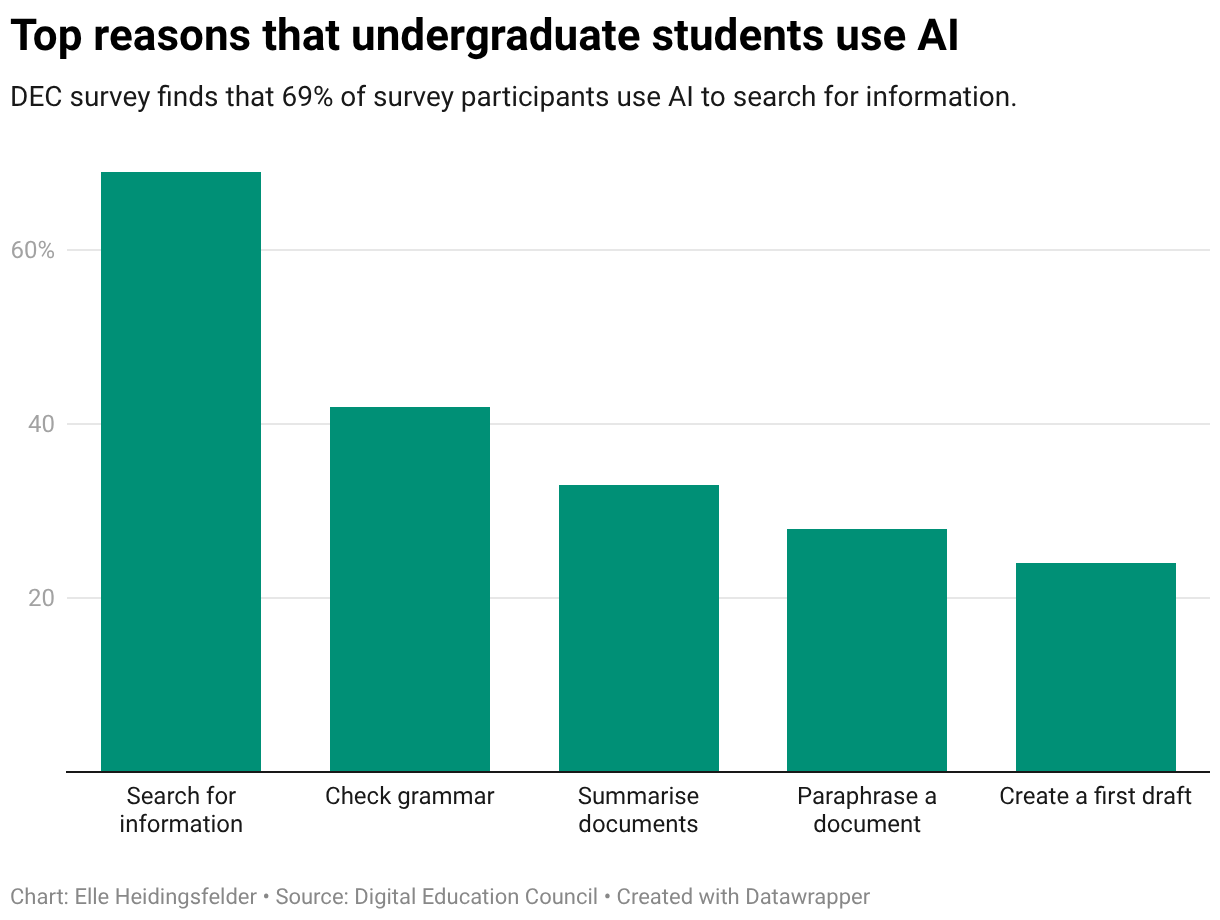
Another study by researchers at the University of Southern California reported that out of a survey of 1,000 college students, the majority used AI for what was deemed “executive help,” using AI to do work for them, as opposed to “instrumental help,” using AI for clarification or for fine-tuning research.
A study conducted at the University of Michigan found that mild to moderate levels of AI usage can help students take stronger notes and perform better on tests. It also found that the vast majority of students preferred more automated forms of AI rather than using it as a collaborator.
College professors are increasingly becoming aware of how prevalent AI usage is, as a College Board survey showed that 74% of faculty expressed suspicion that AI was being used to write essays.
While 45% had a negative view of AI usage, 34% reported a positive view. The biggest contrast was by fields of study, with professors in the liberal arts predominantly holding negative views while those in STEM or business held more positive ones.

Mattei, who teaches courses that incorporate AI usage into the curriculum, such as The Digital Revolution, from Ada to AI alongside author Walter Isaacson, said he holds an optimistic view that AI can be incorporated into class curricula to encourage learning by focusing on “interaction, explaining ideas, and challenging ideas,” Mattei said.
“These are the skills that students still need. It’s an open question how to encourage those skills in a world where there is so much ready access to easy writing tools, but we’re all figuring this out together,” he said.
As artificial intelligence continues to advance, university policies are rapidly changing to reflect both growing usage and concern.
Tulane recently started the Jurist Center for Artificial Intelligence, which works to support research projects centered around AI.
Deen said it is important to strike a balance between communicating effectively without AI, while also learning to prompt and critically evaluate AI outputs.
“As instructors, we want to prepare students for tomorrow’s world, but at the moment we don’t quite know how it will look,” Deen said.
Sophia Finkbeiner contributed to the reporting of this article.