


Bringing a beloved literary classic like “Little Women” to the stage is always a challenge. But Tulane University’s production of “Little Women,” which ran from April 15-20, captured the deep sisterhood between the March sisters and the emotional weight of every obstacle.
Tulane’s production brought Louisa May Alcott’s classic novel to life. Rather than simply recreating what the audience members already know from Timothée Chalamet and Saoirse Ronan’s film adaptation, the performers leaned into the intimacy and heartbreak that have made the story endure.
“Little Women” is a coming-of-age story following the March sisters while their father is off fighting in the American Civil War.
Each sister occupies a distinct role in the family: Beth is gentle and wise, Meg is steady and grounded, Amy is spirited yet vain and Jo is ambitious and intelligent. In Tulane’s understudy performance, Grace Gilchrist, Nora Feinberg, Allie Smail and Cecilia Giebutowski captured that emotional range with clarity, while senior Hadley Magaziner anchored the four sisters as Marmee, their mother, with her warmth, patience and strength.
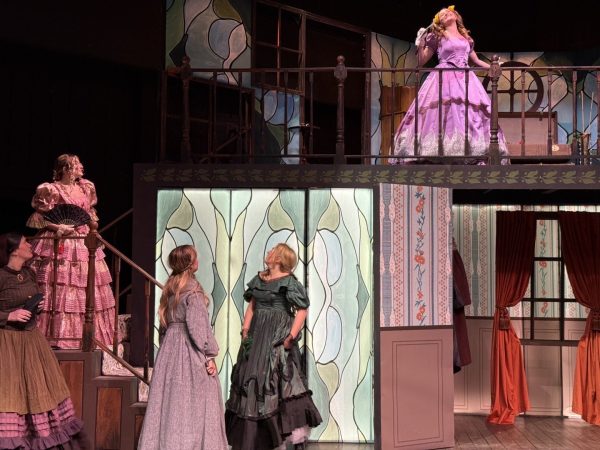
Giebutowski especially stood out as Jo. She captured not only the character’s unwilted ambition, but also her resistance to the expectations placed on women in the 1860s. Giebutowski’s most powerful moments came during the show’s emotional peaks, where her powerful vocals supplemented the passion of the character.
The production’s cast also included Tulane faculty members. Jeffrey Gunshol, a professor of theatre and dance, who played Mr. Laurence and served as the production’s movement director, brought a level of warmth and steadiness to his character.
Beverly Trask, associate professor of dance, brought authority to Aunt March and the character’s commitment to traditional gender roles, which fueled her tension with Jo.
The strength of the performance was also evident in first year Sacha Codron’s role as Laurie. Codron was the only male Tulane student in the production.
“I definitely felt pressure being the only freshman in the show,” he said. “Next to these seasoned actors who do this professionally, it was pretty daunting at first.”
Codron said he gained valuable experience and grew as an actor.
“There’s so much to learn just from watching them,” he said.
As Laurie, Codron delivered one of the production’s most emotionally layered performances. Rather than focusing too heavily on Laurie’s romantic charm, Codron played Laurie with a higher level of restraint.
Codron said he based his performance more on the novel than the film adaptation, an important detail that sets his performance apart.
“I focused more on the book version [of Laurie] — someone who’s a little more shy and reserved.”
Because the show was in the intimate Lupin Theatre, the sense of emotional intimacy extended beyond the cast and into the audience. The performers were inches away from the audience, making them a part of the show’s rhythm.
“As soon as we had an audience, it changed everything,” Codron said. “You could immediately feel the energy shift, and we started feeding off that on stage.”
In a story that is built on quiet moments, the closeness made the production feel less like a performance and more like a shared experience.
The production is defined by the strength of its performances. From seasoned faculty members to student actors stepping into demanding roles, the cast works together to create a version of “Little Women” that feels sincere and emotionally effective.