


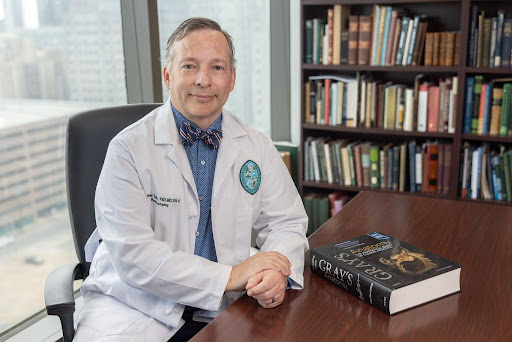
In a historic milestone for both Tulane University and the global medical community, Richard Tubbs, professor of neurosurgery and structural and cellular at the Tulane School Medicine, has been selected as the first American editor-in-chief of “Gray’s Anatomy,” which is widely considered the bible of anatomy textbooks.
First published in 1858, the book has served as a foundational reference for generations of medical professionals and remains a gold standard in anatomical knowledge.
Tubbs’ journey into clinical anatomy and neurosurgery was anything but conventional. He did his undergraduate studies in chemistry and biology at the University of Alabama at Birmingham. It was there, during a night shift working in a lab, that he first heard about a physician assistant program. The opportunity went on to shape the early stages of his career.
After graduating from the program at the top of his class, Tubbs began working at Children’s Hospital in Birmingham alongside pediatric neurosurgeons. Although his initial responsibilities were clinical, his exposure to academic work quickly grew. One of his first assignments was writing a newsletter on concussions.
“It wasn’t an enjoyable situation,” Tubbs said, describing how his work was returned heavily marked with corrections. However, that experience marked the beginning of his journey as an academic writer.
A turning point in Tubbs’ career came when he pursued an anatomical research project. What began as a simple clinical question evolved into a full-scale research study and ultimately inspired him to pursue a graduate degree.
“That original taste of scientific investigation and anatomy and publishing… became addicting,” Tubbs said. “Over time, I enjoyed it so much that I made a career out of it.”
By the time Tubbs became involved with “Gray’s Anatomy,” he had already built a strong foundation as both a writer and editor.
Early Involvements with Gray’s Anatomy
Tubbs’ involvement with “Gray’s Anatomy” began with the 41st edition, when he was invited to contribute as a section editor. His role expanded significantly in later editions, requiring extensive review and editing of complex medical content.
“‘Gray’s Anatomy’ gave me a lot of gray hair over the last six years,” he said. “I would go home and work on it for several hours every night, every weekend … I’ve read the whole thing now, probably 100 times, cover to cover.”
Despite the demanding workload, his dedication and expertise led to his appointment as editor-in-chief, a role that was both an honor and a significant responsibility.
“I love the fact that Tulane is now home to the editor-in-chief of this book,” Tubbs said. “It’s a treasure for our university.”
One unexpected challenge Tubbs faces is clarifying the distinction between the textbook “Gray’s Anatomy” and the popular television show “Grey’s Anatomy.”
“The biggest problem I have now is when you’re talking to non-academic people, and you say you’re involved with ‘Gray’s Anatomy,’ they think it’s the TV show and not the book,” he said. “So I’ve been kind of the spokesperson for changing a lot of people’s minds on the two and establishing that there is this other, rather famous, textbook of anatomy.”
Tubbs emphasizes the importance of preserving the legacy of “Gray’s Anatomy” while adapting to advancements in medical research.
“I hope people continue to see it as a gold standard and a reference source that you can trust,” he said.