


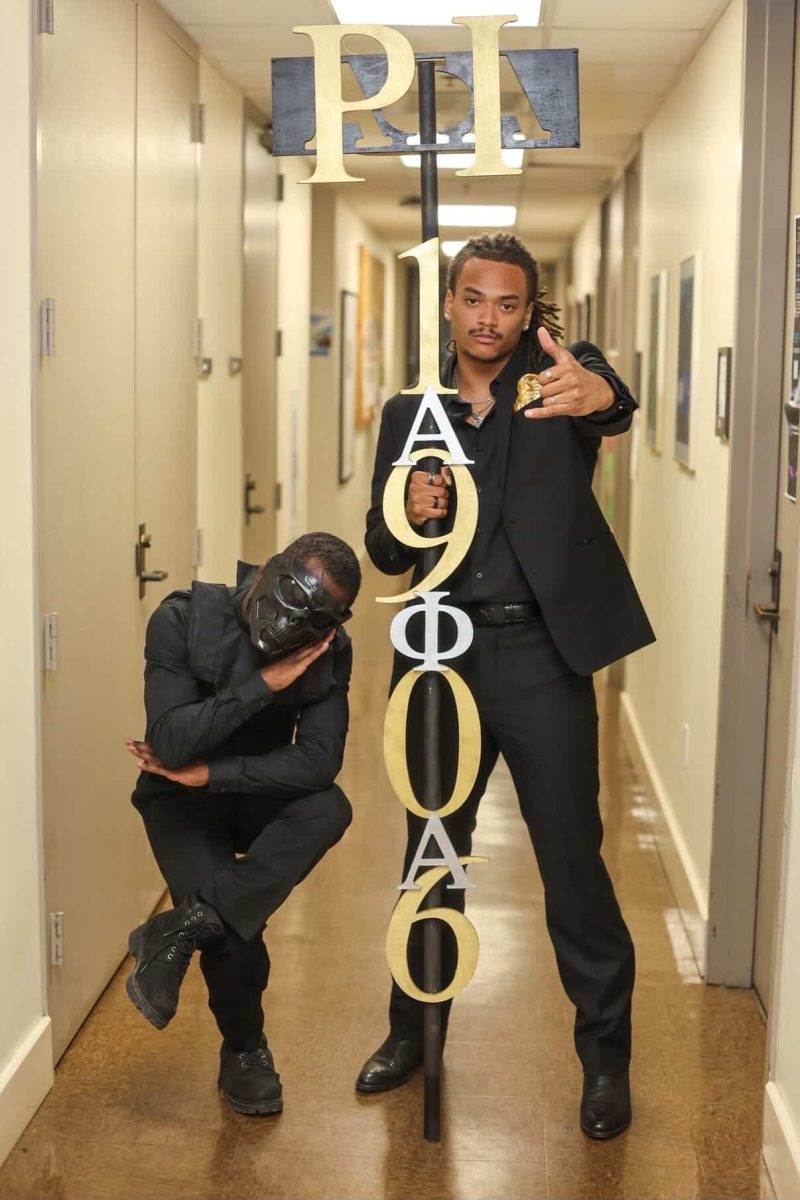
The African American Alpha Phi Alpha fraternity Rho Iota chapter at Tulane University introduced its spring 2026 initiate, Zimir Macius, on the steps of McAlister Auditorium on April 9. This was their first probate since the 2019 spring semester.
At a time when Black students were excluded from white institutions and organizations, Alpha Phi Alpha Fraternity, Inc. was founded on Dec. 4, 1906, at Cornell University by seven Black men, famously known as the “Jewels.” The fraternity was created to provide academic support, brotherhood and advocacy.
Being the first intercollegiate historically Black fraternity, Alpha Phi Alpha later expanded beyond a social organization, with notable members including W.E.B. Du Bois, Rev. Martin Luther King Jr., Thurgood Marshall and Duke Ellington.
Within the National Pan-Hellenic Council, the Alphas set the foundation for other Black Greek-letter organizations, which are collectively known as The Divine Nine.
It was not until November 1989 that the chapter was chartered at Tulane.
Tulane senior Francisco Roman is the current president of Tulane’s chapter of Alpha Phi Alpha fraternity. He joined after he read about some of the organization’s most impactful members, especially W.E.B. Du Bois’s double consciousness theory.
“Those readings were very impactful for how I saw the world, and I realized he was an Alpha,” Roman said. “That was when I was developing the identity of being really pro-Black, and I saw if these two guys are doing the same thing, then it can’t be the wrong thing to do.”
Macius grew up around his aunt, who is a member of the Alpha Kappa Alpha sorority — the first historically Black sorority, founded in 1908 at Howard University.
“She always encouraged the idea of joining an organization … [stressing] the benefits of how great it could be at a young age,” Macius said.
Before Macius joined, Roman was the only member for the 2025 fall semester.
“It was kind of difficult for a while, just organizing and doing a lot of the on-campus things by myself. But the way the chapters work together within the city, it was never just me,” Roman said.
A probate is a public and celebratory presentation of new members after they have been officially initiated within one of the Divine Nine organizations. New members are presented for the very first time as a line, with a name, number and composite.
For Macius, his line name was “Po1ar Vortex,” his number was one and his composite was “Co1d PHront.”
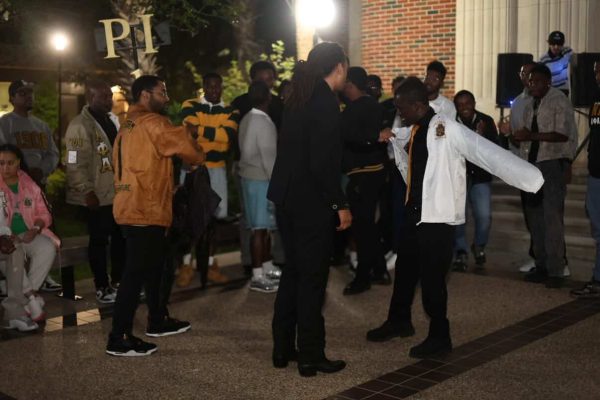
Most probates, especially at historically black colleges and universities, have several line members, but at predominantly white institutions like Tulane, this is not always the case.
For Macius, having a solo probate wasn’t an issue.
“The probate itself wasn’t important to me … it was really just becoming a member,” Macius said. “I realized how beneficial it could be to have a probate … a lot of people showed me a lot of love [and] … made a lot of members want to help me out even more.
In fact, many of the Alphas in attendance were from other universities in New Orleans like Loyola University New Orleans, Southern University of New Orleans, University of New Orleans and Xavier University of Louisiana.
This event included a formal rollout, where Macius was revealed as the new member, followed by coordinated stepping. To signify that Macius had officially “crossed over,” Roman gave him a line jacket.
At the end, members of other Greek fraternities and sororities at Tulane performed their own strolls to conclude the probate.
Greek life is very popular at Tulane, but due to the university’s lack of racial diversity, the Black Greek organizations are underrepresented, as Tulane only has four out of the nine NPHC fraternities and sororities.
“I want to be a known organization on Tulane’s grounds,” Macius said.
“Presence has been increasing and people have been coming out to more events as the years have gone on,” Roman said. “Seeing the difference we’ve had from my sophomore year to now … the general student body is a decent amount more Black and more open to coming out to more events that we have and learning about the work that we put into the community.”
As a new initiate, Macius has made it a mission to continue paying homage to the organization’s founders and their principles, which include dismantling harmful stereotypes.
“I feel like a big thing is stereotypes [about the] D9 are just really messed up and should be talked about,” Macius said. “I need to take away some stereotypes.”