


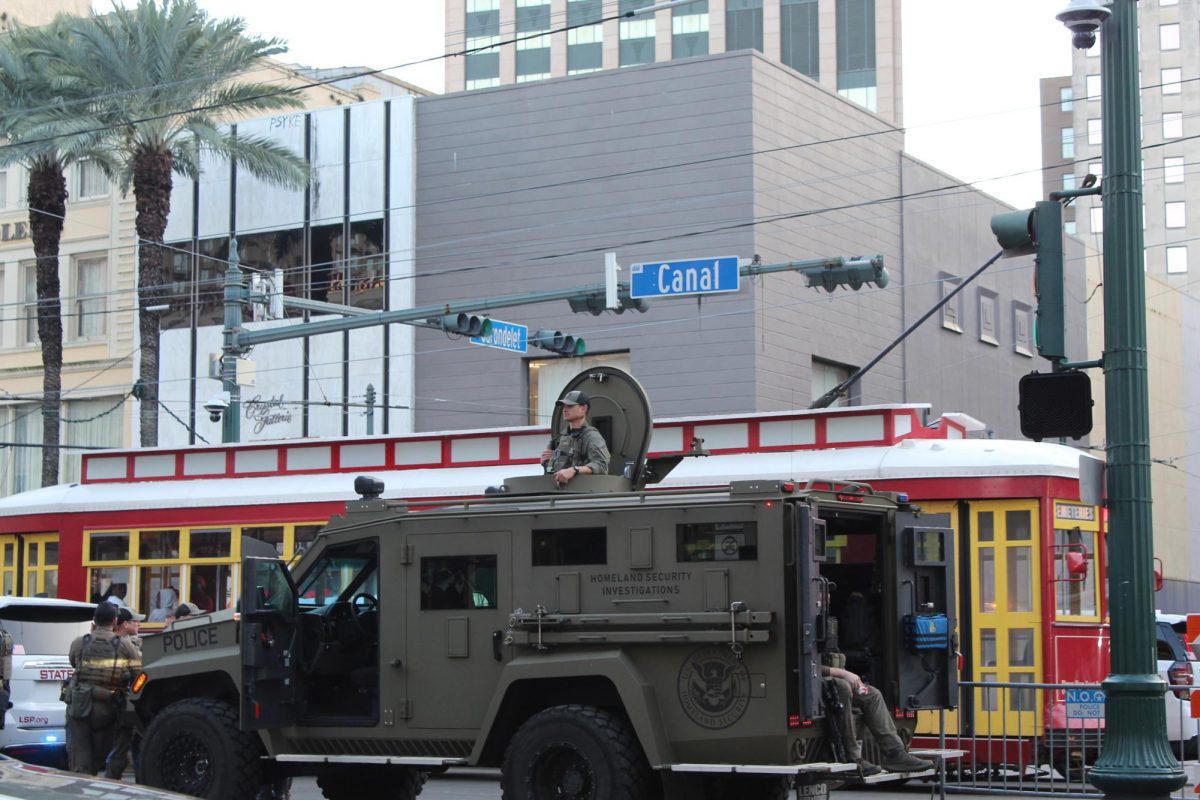
Around 250 federal border agents are set to start arriving in New Orleans this week and begin operations in December, as the Trump administration makes good on its promise to crack down on immigration, according to planning documents reviewed by The Associated Press.
The operation, dubbed “Swamp Sweep” by officials, is expected to begin in earnest on Dec. 1 and will last for two months with the goal of arresting 5,000 people in southeast Louisiana and Mississippi. Much is still unclear about the scope and strategies of the operation.
New Orleans Police Department Superintendent Anne Kirkpatrick said NOPD will “collaborate” with the federal agents, but NOPD officers will not make any immigration related arrests or ask people their immigration status. Except for Kirkpatrick, no New Orleans officials said they communicated with border agents about the impending operations.
The Trump administration recently sent border patrol agents to Charlotte, North Carolina, after operations in Chicago and Los Angeles earlier in the year. Those operations drew controversy for excessive use of force and aggressive tactics. Since being deployed last weekend in Charlotte, more than 130 people have been arrested, according to the U.S. Department of Homeland Security.
If these cities forecast what’s to come in New Orleans, agents may be in green uniforms, driving armored vehicles or unmarked cars. Previous operations targeted work sites, churches, grocery stores and apartment complexes in immigrant communities. The planning documents for New Orleans indicate border agents will target “neighborhoods and commercial hubs.”
CBP is nominally responsible for policing the nation’s borders and ports of entry, while ICE is responsible for immigration enforcement inside the country’s borders, though recent operations have blurred those lines.
Earlier this year, the Trump administration rescinded a policy that protected school campuses and other sensitive areas from immigration arrests. DHS has said that immigration raids do not target schools, but border agents were parked outside a childcare center in Durham, North Carolina, prompting the school to go into lockdown.
Because Tulane University is a private university, border agents would need permission from campus officials or a signed warrant to conduct operations on campus. According to Louisiana law, local police — including the Tulane University Police Department — are required to “fully cooperate” with immigration authorities. This does not include campus security guards, who are employed by a third-party security company and not law enforcement.
Tulane does accept undocumented students and offers all students, staff and faculty immigration support through its immigration attorney. President Michael Fitts said in accordance with the Family Educational Rights and Privacy Act, Tulane would not voluntarily share private information about any student in a 2017 post regarding the repeal of the Deferred Action for Childhood Arrivals Act. This post has since been removed from the Tulane website.
Unconfirmed reports of immigration enforcement sightings on Tulane’s campus have circulated on social media, warning undocumented community members. Because New Orleans is within 100 miles of a port, border patrol agents have extended authority to conduct searches and stop individuals.
Representative Troy Carter, the U.S. House of Representatives member who represents New Orleans, called the planned operations “a political stunt wrapped in badges and guns” in a statement.
“You do not build trust by dropping in armed agents who answer to Washington, do not understand local law, and then sweep through commercial corridors and neighborhoods,” Carter said. “You do not build safety by driving families into the shadows, emptying out workplaces and classrooms, and creating an atmosphere where people are afraid to call the police when they are victims or witnesses of crime.”
Sixteen Louisiana students, including two Tulane students, had their visas revoked in early April for prior criminal activity, not relating to protests. All the visas were later reinstated while ICE designed a policy to “provide a framework for status record termination.” ICE has not yet released an updated policy.
U.S. Department of Justice Assistant U.S. Attorney Elizabeth D. Kurlan said in April that ICE still has the authority to terminate a student visa for conduct that violates the Immigration and Nationality Act. The 1952 law allows the secretary of state to revoke visas if an individual’s presence in the U.S. “would have potentially serious adverse foreign policy consequences for the United States.”